parts / capability / comp-decision-thesis
Compensation decision layer
The layer above the comp dashboard: strategy and priorities become several distinct, measured pay scenarios with a tradeoff radar — never one option. Built on the thesis that pay's only real lever is the exit rate by performance characteristic, and on measurable waste (geo-mispricing, level deviation, over-payment). Pay fairness, bidirectional, with the exit-risk prior honestly labeled.
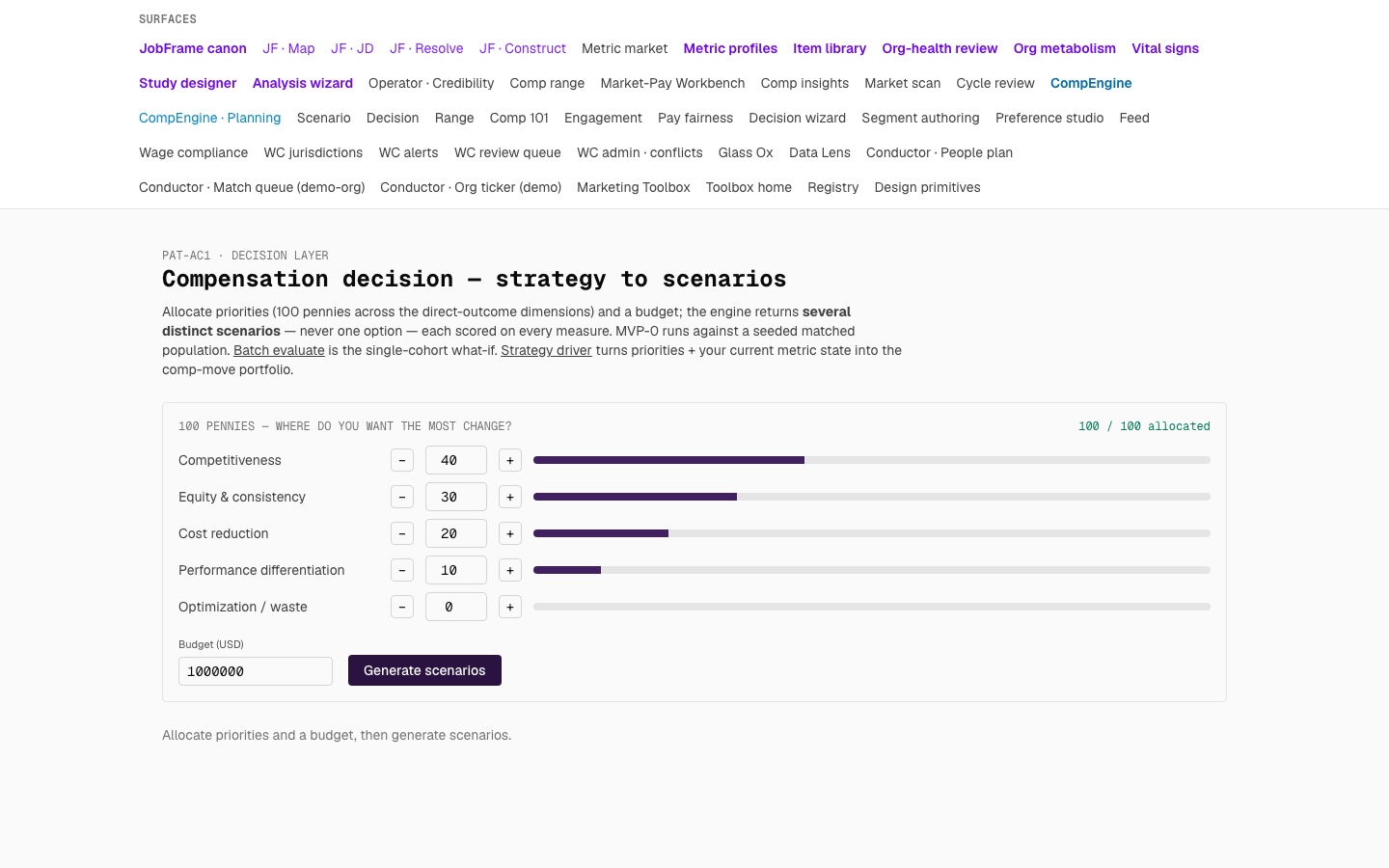
Compensation Decision Layer (the thesis)
Type: algorithm
Origin repo(s): people-analyst (the People Analytics Toolbox) — the anycomp spoke's decision layer
Extraction readiness: the decision loop (strategy → priorities → scenarios → optimizer → tradeoff radar), persisted engagements, and the exit-risk prior are live; the dose-response curve and the full multi-format deliverable set are part of the thesis this layer serves, not all shipped today
Depends on: compensation scenario modeling, the three-value measure set, the exit-risk prior, segmentation dimensions, and the statistical / pay-fairness checks
Last reviewed: 2026-06-08
What it is
The layer above the compensation data. Most comp tools stop at the dashboard — they tell you where the market is and leave you to guess what to do. This is the decision layer: it turns leadership strategy and priorities into several distinct, measured pay scenarios, scores each one on every value dimension, and lays the trade-offs side by side — never a single take-it-or-leave-it recommendation.
The loop runs strategy → priorities → objective → optimizer → simulator → scenarios. You weight what the organization is trying to optimize this cycle, the optimizer searches for the changes that best serve those priorities under budget and policy constraints, and the result is a small set of distinct scenarios plus a tradeoff radar that makes the cost of each choice explicit. Engagements are persisted — strategy, scenarios, impacts, and audit trail saved together — so a decision is reproducible and reviewable, not a spreadsheet that vanishes.
Who it's for
The compensation leader or total-rewards architect who owns a cycle and has to walk into a budget meeting with a recommendation that survives cross-examination — and the executive sponsor (a CHRO, CFO, or CEO) who weights the priorities and wants to see the trade-offs of each choice laid out rather than a single number handed down. The concrete outcome is several scored pay scenarios with the cost of each made explicit on a tradeoff radar, plus a persisted, replayable record of why the chosen one was chosen. It is the engine behind the executive concierge product (AnyComp.AI) rather than a self-serve point tool — this is the layer where pay gets decided across the whole org at once, not one job at a time. Everything it claims about exit-risk dose-response is honestly labeled as a prior under calibration, never as a settled certainty.
The thesis underneath it
The reason to control pay is narrower and sharper than "match the market." Pay has no direct line to firm performance. Its one real lever is the exit rate, sliced by performance characteristic: better pay narrows an employee's set of viable external alternatives, which lowers their exit hazard, which retains the key roles and the high performers you cannot afford to lose. Comp-as-religion — match the market because everyone matches the market — is a false premise. The honest question is dose-response: how much does moving a segment from the 50th to the 75th percentile actually cut its exit hazard, and is that worth the spend?
Today the toolbox ships the foundation of that thesis: an exit-risk prior for a segment, baselined on labor-market data and adjusted by where the segment sits on the compensation-percentile curve. The full calibrated dose-response curve — segment-specific, empirically fit — is the direction this is being built toward, not a finished claim. We label what is calibrated-from-data and what is still a-priori.
Waste — the other half of the comp team's job
A comp team's purpose is to advance objectives while minimizing waste. The decision layer is built to act on measurable waste: geographic mispricing (paying Toledo at California rates), level-distribution deviation, level over-payment, and misclassification. The optimizer can target waste reduction directly. The "startling graphic" the thesis points at — how long accumulated waste takes to self-correct through market movement and attrition versus how long it persists if untouched — is the kind of dissipation read this layer is designed to feed.
Deliverables
The intended output of an engagement is not just a number but a set of formats matched to the audience: an executive dashboard, a results memo grounded in the client's own data, a deck, and the live exec decision surface (the hundred-pennies priority allocation plus the tradeoff radar). The decision surface and the scenario/engagement bundle are live; the broader templated deliverable set is being built out alongside.
Honesty rail
"Pay fairness," not "pay equity," on the consumer surface. The pay-fairness checks are bidirectional — under- and over-payment both surface; remediation is not one-directional. The exit-risk prior is labeled as a labor-market-baselined prior, not a tenant-calibrated certainty, and the firm-level dose-response curve is presented as the calibration goal, not a shipped result.
Related capabilities
- Compensation scenario modeling — the scenario engine this decision layer drives.
- PA Instruments — the strategy-elicitation and value-of-information building blocks the priority loop composes.
- Statistical analysis engine — the pay-fairness and significance checks the scenarios rest on.