parts / capability / field-kits
Field Kits (portable drop-in capabilities)
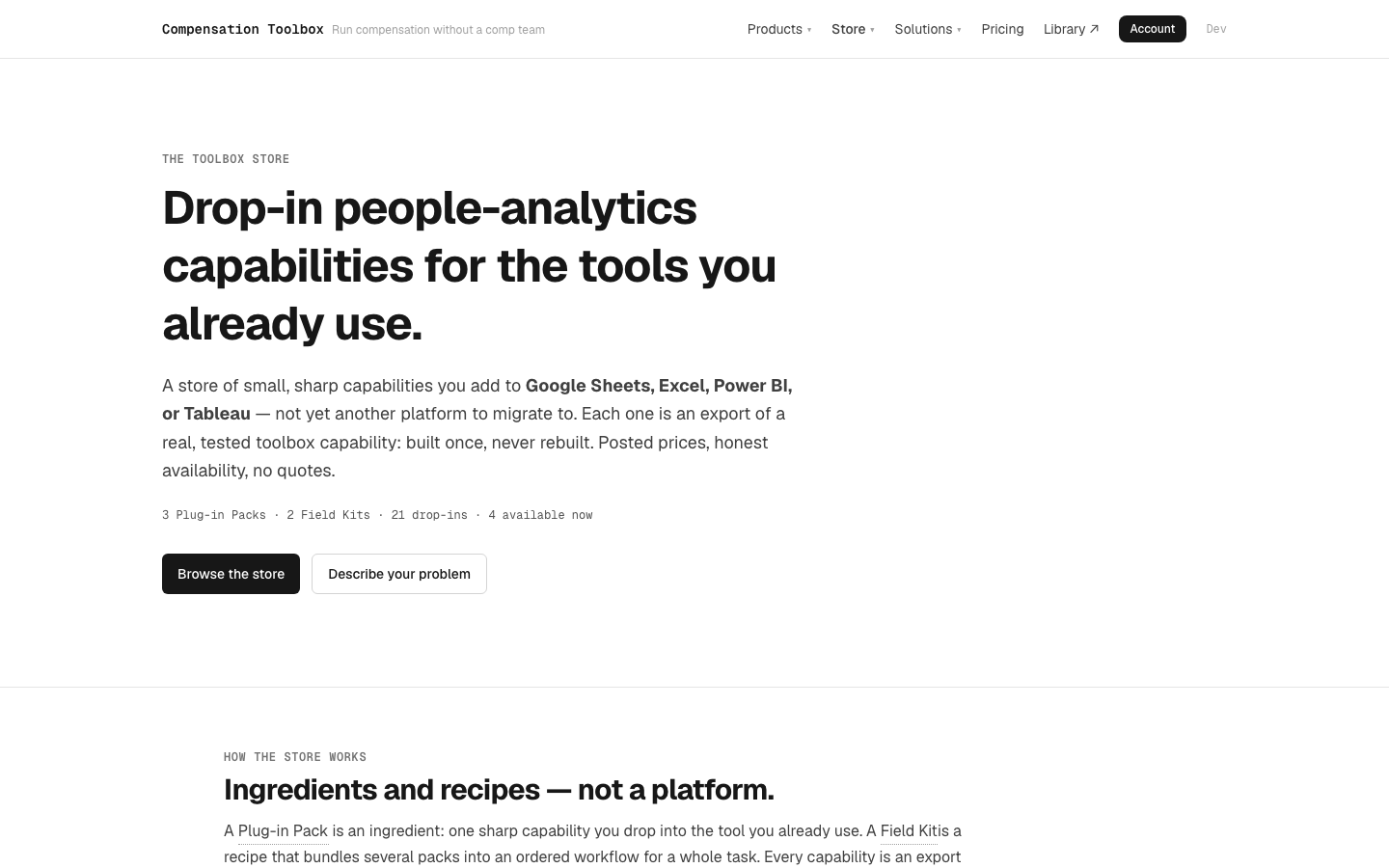
Small, portable drop-in versions of toolbox capabilities that run where the analyst already works — a Google Sheet today, Excel / Power BI / Tableau next. Paste your rows, run the pack, get answers appended back onto every row without moving your data. Each pack exports one canonical toolbox capability rather than re-implementing it, and surfaces every problem instead of silently dropping it.
Field Kits (portable drop-in capabilities)
Type: integration
Origin repo(s): people-analyst (the People Analytics Toolbox) — src/field-kit/, exporting toolbox spoke capabilities; first pilots drawn from org-graph, job-family-agent, and segmentation-studio
Extraction readiness: live as a framework with three pilot packs (hierarchy abstractor, SOC mapper, segmentation adjuster); more capabilities export as the line grows
Depends on: the toolbox spoke each pack exports (a Field Kit never re-implements an algorithm — it marshals data in and out of the canonical one)
Last reviewed: 2026-06-08
What it is
Small, portable, drop-in versions of toolbox capabilities that run where the analyst already works — a Google Sheet today, Excel / Power BI / Tableau next — instead of asking them to move their data into a new system. You paste your rows, run the pack, and it appends new columns back onto every row: the answer joined to your data, in your spreadsheet, without touching the source.
A Field Kit is a thin host adapter wrapped around one hostless capability core. The core does the work; the adapter only moves tabular data in and out. The same core that powers a hosted toolbox endpoint powers the drop-in — so the spreadsheet pack and the enterprise API never disagree.
Who it's for
The working people-analytics or comp professional who lives in a spreadsheet, has a deadline, and does not want to migrate their data into yet another platform to answer one bounded question. They paste their rows, run the pack, and get the answer joined back onto every row in the tool they already trust. The concrete outcome is a defensible result this week — hierarchy attributes re-joined to a headcount file, titles mapped to occupation codes, a segment recoded — without moving sensitive data anywhere for the basic tier. This is the self-serve, deconstructed face of the toolbox: capabilities sold one at a time to the professional who runs them, the opposite end of the spectrum from the run-it-for-you executive concierge products. Every pack surfaces its problems instead of silently dropping them, so the analyst sees exactly what could not be computed and why.
The pilots
- Hierarchy Abstractor — give it an employee list with a manager column and it walks the reporting tree, then re-joins the structure back to every row: leader-per-level, org level, depth, span of control, indirect-report count. Now you can pivot and report by hierarchy without hand-editing anything. It composes the
org-graphspoke's ancestor-resolution under the hood. - SOC Mapper — maps job titles to standard occupation codes, with review flags. The local version does heuristic major-group tagging; the enterprise version upgrades to alias- and semantic-validated six-digit codes through the
job-family-agentresolver. - Segmentation Adjuster — recodes a source column into an adjusted segment through an analyst-maintained mapping. A pure view layer: it never touches the underlying data, so the recode is reversible and auditable.
The trust gate
Every pack surfaces its problems instead of silently dropping them. Cycles in a reporting tree, orphaned rows, missing managers, multiple roots, low-confidence matches — each comes back as an explicit warning attached to the row it affects. A pack never quietly defaults a value it could not compute; it tells you what it could not do and why.
Why it is shaped this way
- Export, never re-implement. Each pack names the toolbox capability it exports and calls that one core. There is no second, drifting copy of the algorithm living in a macro.
- Residency-friendly by default. The Sheets adapter runs in-sheet with no backend, so sensitive data never has to leave the analyst's environment for the basic tier.
- One core, many hosts. The capability is written once, hostless; Sheets, Excel, Power BI, and Tableau adapters are thin marshalling layers over it.
- The trio ships together. Each pack arrives as code, a wizard, and an illustrated manual — the same declarative discipline the rest of the toolbox uses for discrete actions.
Related capabilities
- Segmentation / dimension management — the spoke the Segmentation Adjuster exports.
- Identity resolution + multi-CSV join — a sibling data-front-door capability.
- AI field mapping → canonical schema — the canonical-mapping layer the kits lean on when crossing a data boundary.