parts / capability / jobframe
JobFrame (universal job framework)
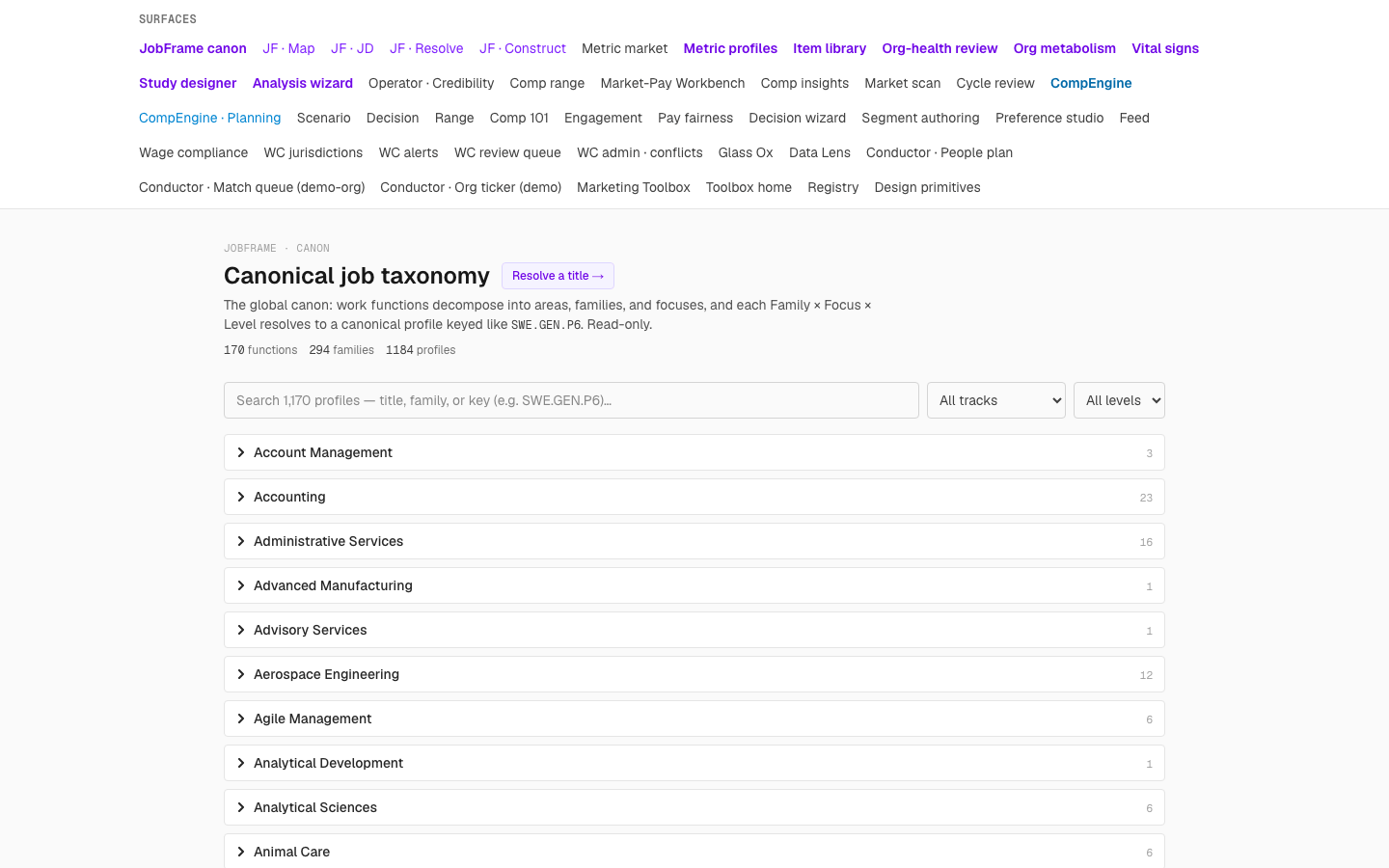
A governed, canonical map of work — every job as a Family x Focus x Universal-Level profile with verbatim definitions and a deep alias index, built data-first from real job materials. Resolve a messy title, classify free text, construct a profile top-down, bulk-map an HRIS, and export — all over HTTP and MCP. The spine other sources map into, not a fuzzy guess.
JobFrame (the universal job framework)
Type: data
Origin repo(s): people-analyst (the People Analytics Toolbox) — the job-family-agent spoke
Extraction readiness: live — the canon (family × focus × level profiles, aliases) plus the resolve / construct / classify / export surface ship over HTTP and MCP; richer matching is a documented follow-up
Depends on: the SOC / O*NET occupation registry, the canonical-segmentation libraries, and the data-first canon built from the real corpus (not generated from a blank page)
Last reviewed: 2026-06-08
What it is
A governed, canonical map of work: every job described as a Family × Focus × Universal-Level profile — for example SWE.GEN.P6, software engineering, general focus, principal level — with verbatim profiles, components, and a deep alias index built from a real corpus of job materials and segmentation datasets, not invented. It is the work-intelligence substrate that other tools map into: the spine, not a fuzzy guess.
The canon was built data-first — assembled from the source materials directly, with generation reserved only for the edges (level dimensions and gap cells, produced from the same source's own prompts). Levels carry corrected, explicit semantics (entry through principal). The result is a profile library covering hundreds of families across the full level ladder, each profile with a real definition.
Who it's for
Anyone whose work breaks when job data is messy — the comp analyst pricing roles against the market, the people-analytics team trying to segment a workforce by what people actually do, the HRIS owner staring at a title field with five spellings of the same job. They need a spine: one canonical, governed structure that other sources map into, not another fuzzy classifier that guesses. The concrete outcomes are mechanical — a messy title resolved to ranked Family × Focus × Level candidates with confidence and evidence, free text classified to standard occupation codes, an HRIS extract bulk-mapped with a review-and-correct loop, a profile constructed top-down instead of from a blank page, any profile exported as JSON or Markdown. It is consumed by humans over HTTP and by AI agents over MCP, and it sits underneath the comp and segmentation work as their shared definition of work — so those tools stop disagreeing about what a job is.
What you can do with it
- Resolve a messy title — feed it an observed job title and it returns ranked Family × Focus × Level candidates, each with a confidence band, the evidence behind the match, and a recommended action. The front door for cleaning up an HRIS title field or a requisition.
- Classify free text — a stateless, public classifier takes free text and returns up to several standard occupation matches with confidence, plus a best-guess family and function. Direct occupation-code mentions in the text override the heuristic.
- Construct top-down — assemble a draft profile from a family, focus, and level (plus context modifiers) instead of starting from a blank-page job description.
- Bulk-map and review — map an HRIS extract or a single job description against the canon, with a review-and-correct loop and a tenant overlay so an organization's local decisions sit on top of the shared canon without forking it.
- Export — pull any canonical profile out as JSON or Markdown.
The whole surface is reachable from a browser over HTTP and from an AI agent over MCP — the same canon, two transports.
Why it is shaped this way
- Data-first, not generative. The canon is built from real job materials verbatim; generation is confined to filling level dimensions and gap cells from the source's own prompts. The framework's credibility rests on being grounded, not synthesized.
- A spine, not a fuzzy match. Rigorous job architecture (family → function → focus → level, with occupation crosswalks already attached) is the structure other sources map into. The join is deterministic, not a similarity score against the spine.
- Governed, with a tenant overlay. The shared canon stays canonical; an organization's corrections live in an overlay layered on top, so consumers vendor a stable contract while local intelligence accumulates.
Related capabilities
- Segmentation / dimension management — the canonical-value backbone JobFrame's aliases draw on.
- Metric definition registry + tier classification — a sibling canonical-registry capability.
- Compensation scenario modeling — a downstream consumer that prices roles against the JobFrame spine.