parts / capability / organizational-metabolism
Organizational Metabolism
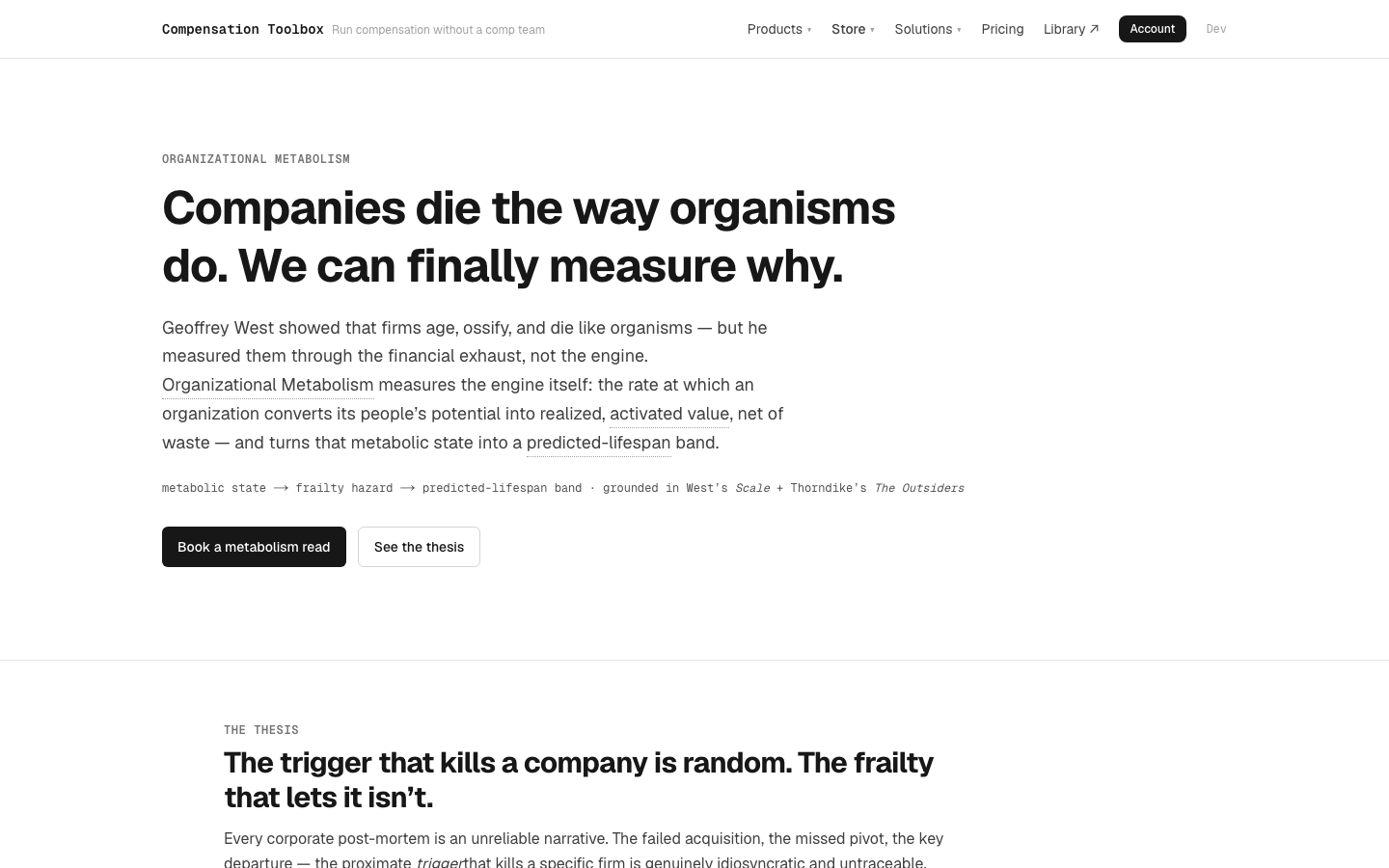
Measure the engine behind why companies age and die: activated-value throughput divided by dissipation. The Metabolism Index runs through a frailty-hazard model to a predicted-lifespan band, read through a panel of survey-based vital signs. The parameters are a-priori-calibrated and the corporate-mortality validation is an open evidence challenge — framed as such, never as proven.
Organizational Metabolism
Type: algorithm Origin repo(s): people-analyst (the People Analytics Toolbox) — composed over the value, waste, exit-risk, survey, and network analytics the toolbox already ships Extraction readiness: the Index and the vital-signs feed are live; the Tier-1 corporate-mortality validation is an open evidence challenge, not a shipped result Depends on: the activated-value and net-activated-value analytics, the exit-risk hazard model, the longitudinal survey engine (the vital-sign instruments), and the network-analysis spoke (the connectivity feed) Last reviewed: 2026-06-08
What it is
A way to measure the engine behind why companies age and die — not through the financial exhaust, the way most corporate-longevity work does, but through the engine itself: the rate at which an organization converts its people's potential into realized, activated value, net of waste.
Geoffrey West showed that firms age, ossify, and die in regular, measurable ways. Organizational Metabolism measures the metabolic state directly and turns it into a headline fitness number, a panel of protective and acute vital signs, and a predicted-lifespan band.
Who it's for
The executive — a CEO, board member, or head of strategy — who suspects the organization is quietly ossifying and wants a read on it before the financials confirm it, when correction is still cheap. And the people-analytics leader who has to give that executive a number that is honest about its own uncertainty rather than a confident fiction. The concrete outcome is a single fitness reading plus a vital-signs panel that says which part of the metabolism is weakening — innovation climate, entrepreneurial energy, leadership mistake-risk, network connectivity — so the intervention has a target. It is deliberately not sold as a verdict: the predicted-lifespan band is a forecast, the firm-level parameters are a-priori-calibrated, and the corporate-mortality validation is an open evidence challenge. The reader who wants certainty is the wrong reader; the reader who wants an early, falsifiable signal is exactly the right one.
The headline reading
The Organizational Metabolism Index is the engine divided by the leak: activated-value throughput ÷ dissipation. Higher is fitter. That metabolic state runs through a frailty-hazard model — the same survival math the toolbox already uses for person-level exit risk, lifted up to the whole firm — to produce a predicted-lifespan band: a median plus a range, with the frailty concentrated in the key positions (the "vital organs") called out separately.
The trigger that kills a specific company is genuinely idiosyncratic — the failed acquisition, the missed pivot, the key departure. You cannot predict the bullet. But the frailty that lets the bullet land — the accumulated value-waste, the depleted reserve, the elevated leadership risk — is measurable, and it is the real cause.
The vital signs
The metabolism is read through a panel of survey-based vital signs, each fielded with the same psychometric discipline as the rest of the platform — never an off-the-shelf engagement score. Two protect the metabolism; one acute factor multiplies the risk:
- Culture of Innovation (protective) — the climate an organization keeps for innovation: shared vision, the safety to challenge and to fail, real support for new ways of working. The factor that keeps a firm adaptive instead of narrowing.
- Entrepreneurial Energy (protective) — the organization's capacity to generate and act on novel value, the decentralized energy the best capital allocators release.
- Leadership Mistake-Risk (acute) — the dangerous leadership qualities (hubris, dissent-suppression, fad-chasing, erratic judgment) read from the people who see them up close: a leader's own direct reports. A hazard multiplier, not a protective score.
Alongside the survey panel, the toolbox's network-analysis spoke contributes a connectivity reading — how reachable, cohesive, and robust the collaboration graph is — as a further protective input to the metabolic state. It is reported as an aggregate org-level index, never as a re-identifiable map of who talks to whom.
Honesty rail — this is an open challenge, not a proven law
The Index composes analytics the toolbox already ships — value, waste, exit risk — over their published contracts. There is no new black box. But the firm-level frailty-hazard model's parameters are a-priori-calibrated today, and labeled as such, exactly the way the person-level exit-risk model is. The lifespan band is a forecast, not a verdict.
The strong version of the thesis — that internal metabolic state predicts corporate death even after conditioning on age, size, and standard financials — is a falsifiable claim we have not yet closed. The decisive Tier-1 test rebuilds the corporate-mortality panel, attaches a publicly constructable value-waste proxy, and asks whether the senescence signal survives. We publish the estimand, the proxy recipe, and the falsification rule for a hostile outside researcher to run. Until that direct test lands, we present this as the open question it is — we would rather show you the open challenge than pretend it is closed.
Related capabilities
- PA Instruments — the measurement building blocks the vital-sign instruments and the value/waste analytics are assembled from.
- Compensation scenario modeling — where the value-waste leg of the metabolism is acted on directly.
- Monte Carlo simulation engine — the stochastic engine behind the forecast band.