Bicycle Guide↗ bicycle.guide
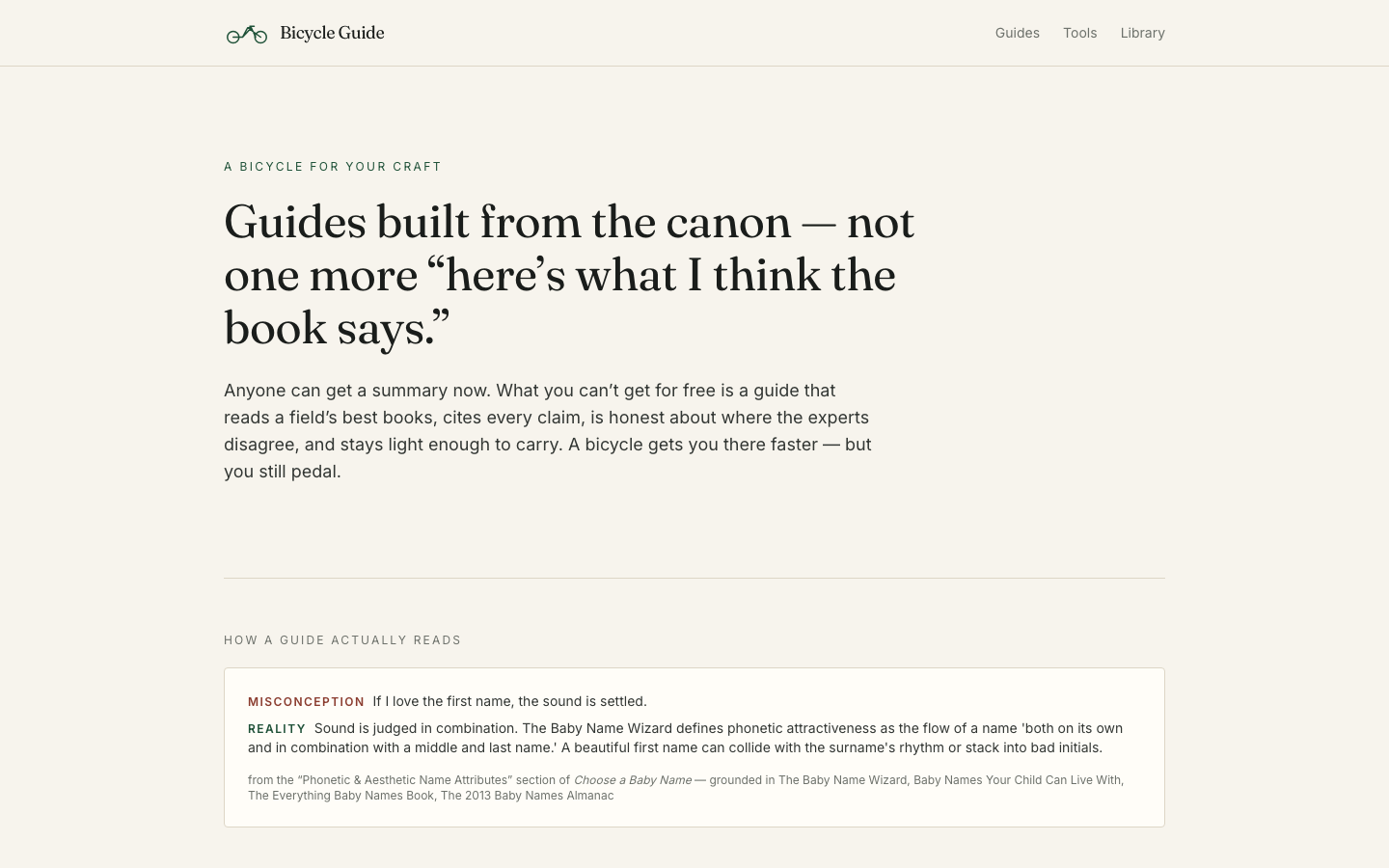
Bicycle Guide landing — grounded how-to guides built from a field's actual canon.
Grounded how-to guides built from a field's actual canon — cited per claim, aware of where the experts agree vs. disagree, light enough to carry. One engine (CanonicAI's cross-book models → the Bicycle generator), many focused .guide fronts. A bicycle gets you there faster, but you still pedal.
Anyone can now get a summary of any book for free — "I read it, here's what I think it says." It's opaque, ungrounded, and adds no value you couldn't get from a chatbot. The how-to genre ("for Dummies," short introductions, AI digests) flattens a contested field into one tidy answer and shows none of its work. There was no guide that reads a field's best books, cites every claim, names where the canon genuinely disagrees, and stays essential.
A capability-guide generator that turns a CanonicAI reconciled cross-book factor model (the cluster_model — constructs + typed relationships, synthesized across the field's canon) plus per-book extractions into a published guide: a visible factor-model core (diagrammed), a three-tier learning journey (Foundations → Practitioner → Advanced), per-section Misconception→Reality (the corpus's They-Say→I-Say corrections), how-to + pitfalls, the canon's honest tensions (consensus vs. outlier, with an evidence-graded position on outliers), and every claim linked to its source book's /library profile. A multi-front platform — one codebase, many focused .guide domains, each canonicalizing to the umbrella so it captures a vertical's audience without duplicate-SEO. First guide: Start a Company; first focused front: startupleader.guide.
- 01Cross-source by construction — a guide is the reconciled consensus of a field's best books (not one author's take), with a single-source path: drill into any cited book's own profile
- 02The factor model is the spine, made visible — constructs + causal relationships diagrammed, then operationalized section by section. A model, not a tip list
- 03Misconception→Reality / They-Say→I-Say as the signature device, drawn from the corpus's own extractions — the myth named, then corrected, with provenance
- 04An 'aware' stance, not neutral both-sidesing — name wide consensus vs. outlier thinking; on outliers, take a position graded by evidence quality
- 05One engine, many fronts — focused .guide storefronts off a single codebase + data model, with rel=canonical to the umbrella (focus capture, no duplicate content)
- 06Drafts, the program governs — guides ship draft until the voice/evidence gate passes; provenance on every claim
v1 live: the Start a Company guide (10 sections across three tiers, 20 Misconception→Reality pairs, 5 honest tensions, 88 citations reconciled from 33 books) on bicycle.guide, plus focused fronts — the founder-framed startupleader.guide and the family-life thefamilyalmanac.com. The generator is corpus-agnostic — any how-to cluster CanonicAI ingests becomes a guide by the same recipe.
Bicycle Guide is the portfolio's practical-capability surface: the home for how-to corpora that don't belong on peopleanalyst (people analytics / AI / strategy), Vela (the human experience), or Performix (performance & leadership). It's also where the corpus engine proves it can turn books into something only AI can do well at scale — a grounded, honest, essential guide — and funnel readers from a free web guide toward deeper paid guides, the books themselves, and the toolbox.