DevPlane
↻ brief 69d ago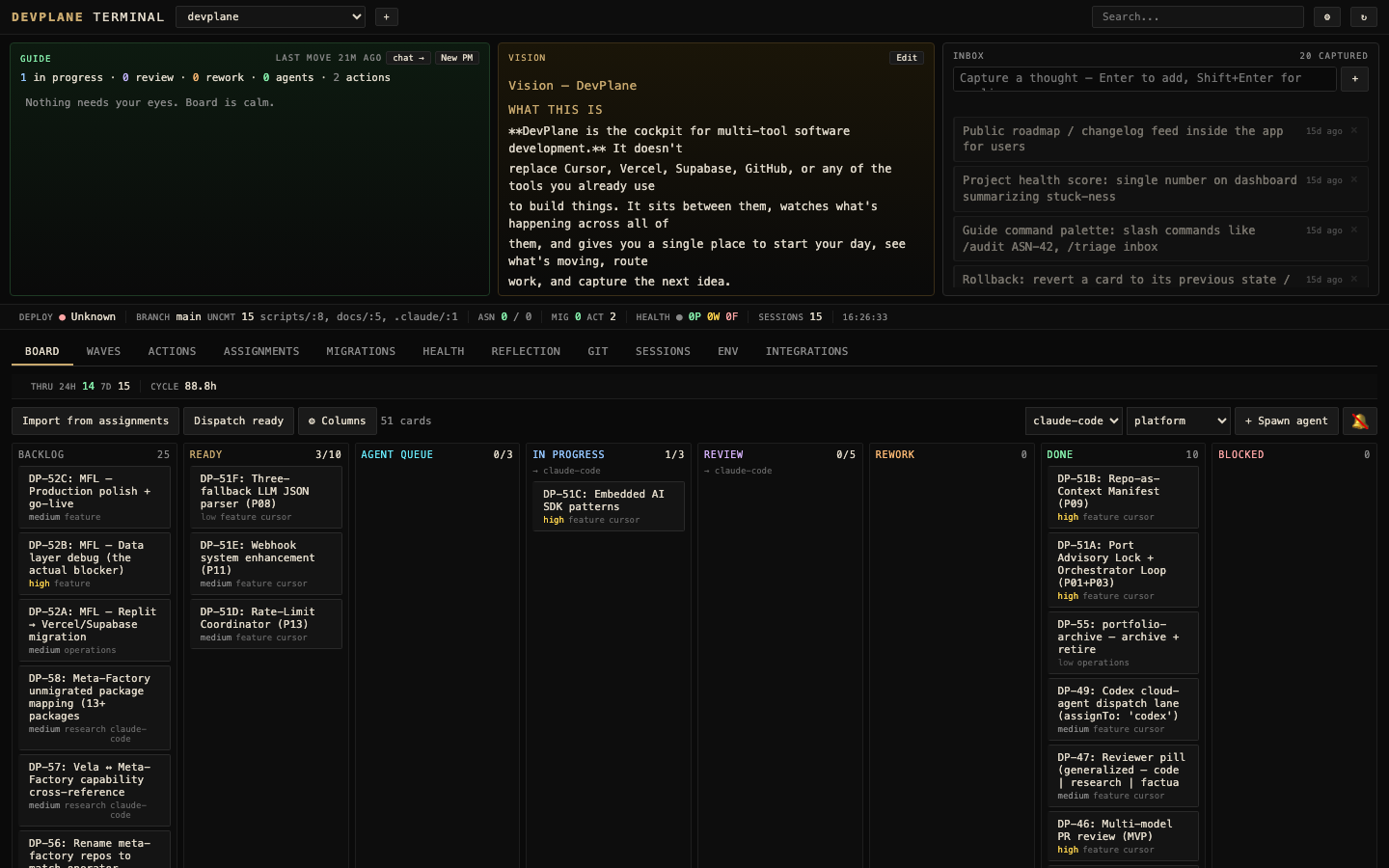
Dashboard — multi-tool kanban with two-phase actor handoff and per-card execution telemetry
Two products in one project. (1) A local cockpit for multi-tool software development — assignment registry, two-phase actor handoff, coordination-event log, MCP server, CLI, Chrome extension; the operator-side measurement layer AI coding tools' agent-side metrics miss. (2) The portfolio's shared engineering brain — pattern library, architecture maps, session handoffs, cross-project assignment registry, API registry, decision log, capabilities catalog, and the capability-architecture doctrine the whole portfolio is built against.
- Customer
- Solo founders and small teams running heterogeneous AI coding tools across a portfolio of products, plus the cross-repo engineering hubs that need patterns, maps, decisions, and capabilities legible across every product in that portfolio.
- Problem · external
- AI coding tools measure productivity from the agent's side — lines produced, tasks completed, time-to-PR — and there's no operator-side cockpit that catches what an operator running multiple agents actually has to do. Meanwhile every repo accumulates its own patterns, maps, and decisions; most stay locked inside the repo that produced them.
- Problem · internal
- The feeling that the tools don't know about each other and that the same primitive is being rebuilt five times across five products without anyone noticing.
- Problem · philosophical
- If AI-productivity claims rest on agent-side measurements alone, the Ironies of Automation will go uncaught.
- Guide
- A local dashboard + MCP server + CLI + Chrome extension orchestrating one target project at a time, plus a cross-portfolio documentation hub — patterns, architecture maps, session handoffs, assignment registries, API surfaces, decisions, capabilities catalogs — legible across every product in the portfolio. The continuous coordination-event log doubles as the research apparatus for the C1 risk-compensation field study (pre-registered, Bainbridge 1983).
- Plan
- Point `dp` at any repo → multi-tool kanban surfaces the work; agents claim assignments through a registry; completion blocks close each card with structured machine-readable artifacts; cross-portfolio patterns, maps, and decisions are reconciled into one legible surface.
- Success
- One operator coordinates Cursor + Claude Code + Codex + custom agents through one board; the production telemetry tests AI-productivity claims in pre-registered terms; every new product stands on the last one's shoulders rather than rebuilding from scratch.
- Failure avoided
- AI-tool productivity claims that systematically miss what the operator does; portfolios where the same primitive is rebuilt five times and nobody notices.
Two convergent problems. AI coding tools' productivity claims rest on agent-side measurements — lines produced, tasks completed, time-to-PR. If the Ironies of Automation are operative (operator vigilance falling as agent reliability rises), those measurements systematically overstate net effect. There is no operator-side cockpit catching the loss. And on the portfolio side, every repo accumulates its own patterns, architecture maps, handoffs, and decisions — most of which are unreachable from any other repo. The result is rebuilding the same primitive five times across five products and not noticing.
A local dashboard + MCP server + CLI + Chrome extension that orchestrates day-to-day work inside one target project (kanban, actions, dispatch, session reports). A multi-agent kanban with a completion-block protocol that tracks per-card execution across heterogeneous AI tools. Two-phase actor handoff (builder → reviewer) where the second transition requires an artifact only the reviewer can produce. Cross-tool sync via a hub SDK so an operator coordinates Cursor, Claude Code, Replit, and other agents through one board. The continuous production telemetry that runs the C1 risk-compensation field study — a pre-registered test of Bainbridge 1983 in real coding work, with hypotheses, analysis plan, and falsification criteria specified before data accumulates. The cross-project documentation hub: pattern library (241 indexed production patterns, P01–P241), architecture maps per repo, session-handoff archive, assignment registry across repos, API registry, decision log, capabilities catalog, and the Portfolio Capability Platform Playbook that governs how every product folder is structured (src/capabilities/<name>/{contracts,core,adapters,ui,tests} with extraction maturity levels 0–3). Performix is the first reference implementation of the doctrine.
- 01Two-phase actor handoff (builder → reviewer) where the second transition requires an artifact only the reviewer can produce — enforces review without trusting it
- 02Coordination-event log as a research instrument, not just an audit trail — the apparatus for the C1 risk-compensation field study
- 03Completion blocks as a protocol — every assignment ends with structured machine-readable completion, not free-text close-out
- 04Hub-and-spoke sync between heterogeneous AI tools so an operator coordinates Cursor + Claude Code + Replit + custom agents through one board
- 05Cross-project documentation hub — patterns, maps, handoffs, assignments, APIs, decisions, and capabilities legible across every repo in the portfolio. Reduces the rebuild-it-five-times tax that solo-cadence multi-product work would otherwise pay.
- 06Capability Architecture Doctrine — the portfolio-wide playbook for structuring applications as compositions of extractable capabilities with contracts, adapters, and props-driven UI. Performix is the first reference implementation; subsequent products inherit the structure.
- 07Coordination-pill extraction (DP-165) — the first pill the repo is building toward. The `src/coordination/` boundary is enforced (no outside imports, no `DevPlaneConfig` references; accepts a `CoordinationStorage` adapter). End state: `@devplane/coordination-core` v0.1.0 published to npm; first external consumer planned as the People Analytics Toolbox.
- 08Pattern-propagation stack — `dp patterns` CLI + `devplane_patterns_search` / `devplane_patterns_get` MCP tools + `docs/PATTERNS/MASTER-PATTERNS.md` as the reconciled canonical surface. Patterns are now discoverable from any agent over MCP, from the operator over CLI, and actively reconciled rather than write-only.
- 09Portfolio Brief Protocol — sister repos emit StoryBrand-shaped `docs/portfolio-brief.json` files; the hub syncs them; PA-site renders them as per-project detail pages with staleness badges. Cross-portfolio narrative state is now machine-readable and continuously refreshed rather than scattered through readmes.
- 2026-05-18Portfolio reconciliation: PAT-113 directives-hub contract mirrored,
~/.devplane/portfolio.jsonregistry refreshed (14 → 15 projects, 7 new capability entries on toolbox), DP-150 closed (e47fef8) - 2026-05-18Coordination-pill E-2 (DP-167): migrated audit-log + rate-limit into
src/coordination/under the no-outside-imports boundary (c3fe41c) - 2026-05-18Coordination-pill E-1 (DP-166): earmarked
src/coordination/+ README defining the extraction boundary for the future@devplane/coordination-corenpm package (9cfc4c4) - 2026-05-18DP-165 scoping doc: 8-phase coordination-pill extraction plan filed at
docs/COORDINATION-PILL-EXTRACTION.md(9821fcf) - 2026-05-18DP-148 close: performix re-vendored to segmentation-studio 2.2.0 (
ead3fa2) - 2026-05-18DP-149: CanonicAI OLD/PROD split in registry + memory + mission doc (
aa92754) - 2026-05-18DP-164:
/api/triage/coverageendpoint +dp triage --coverageCLI surface (f446f2f) - 2026-05-17Pattern propagation stack:
devplane_patterns_search+devplane_patterns_getMCP tools (DP-158),dp patternsCLI (DP-157), devplane patterns reconciled into MASTER (DP-160), P234 toolbox/Light-Mode Design System reconciled (1d2b08c) - 2026-05-14Tier 2 portfolio SOTA snapshot pass complete; DP-148/149/150/151 follow-ups filed (
c10448a) - 2026-05-13DP-129 cross-portfolio pattern catalog refresh (mirror + master + paradigms) — PR #65 merged
- 2026-05-11DP-139 MCP-control Phase 2: CanonicAI adapter + first composite — PR #63 merged
- 2026-05-08DP-123 cross-portfolio status view — PR #62 merged
- 2026-05-04DP-110 Vercel deployment of
devplane.apphosted dashboard — PR #61 merged
- ·Coordination-pill extraction (DP-165 master). E-1, E-2 DONE; E-3 next — migrate
coordination-events.ts+claim-override-events.ts(~468 LOC, SQLite-backed; extendsCoordinationStoragewithopenSqlite(name)). End state:@devplane/coordination-corev0.1.0 published to npm. - ·DP-104 Research substrate consumer integration. Gated on CanonicAI MF-001/002/003.
- ·DP-137 Supabase key drift audit across four repos (needs interactive
vercel env pull; not solo-safe). - ·DP-136 Operator-console visual identity. Deferred under the substrate-first direction.
- ·DP-135 Vercel REST API pattern doc. Low priority, picks up any session.
| Component | Stage | Reuse |
|---|---|---|
Coordination-pill (@devplane/coordination-core)src/coordination/ | early-build | Pre-publish. Phases E-1/E-2 of 8 shipped; boundary enforced (no outside imports, no DevPlaneConfig references). First external consumer planned as people-analytics-toolbox (E-7a), then meta-factory-prod (E-7b). |
DevPlane MCP serversrc/mcp-server.ts | production | Consumed by vela via vela/.cursor/mcp.json (absolute tsx path). ~27 tools exposed including devplane_patterns_search / devplane_patterns_get. |
| Portfolio HTTP API [ docs/API-REGISTRY/devplane-portfolio.md](API-REGISTRY/devplane-portfolio.md) (routes in src/server-app.ts) | production | /api/portfolio* family consumed by meta-factory-prod's MetaFactory Console (CanonicAI's serving shell). |
| Agent HTTP API [ docs/API-REGISTRY/devplane.md](API-REGISTRY/devplane.md) (routes in src/server-app.ts) | production | /api/agent/* — any subagent can drive DevPlane over HTTP (completion log, claim, kanban, halt). Optional X-DevPlane-Key auth. |
Pattern reconciliation infrascripts/reconcile-patterns.mjs + docs/PATTERNS/MASTER-PATTERNS.md | production | Canonical cross-repo pattern aggregation; mirrored by the people-analytics-toolbox. |
dp CLIbin/dp.js | production | Operator-facing. Not yet packaged as a standalone npm distribution; invoked locally inside this repo. |
Two products in one repo: a local operator cockpit (Hono + Server-Sent Events + SQLite + CLI + MCP server + Chrome extension, served at `localhost:4000` by `npm start <project-dir>`) and a cross-portfolio documentation hub (`docs/` — patterns, architecture maps, session handoffs, cross-project assignment registries, API surfaces, decisions, periodic SOTA snapshots, capabilities catalog). The cockpit is the dispatch and telemetry layer; the docs hub is the portfolio's shared engineering brain. The two reinforce each other — the cockpit collects coordination-event data the docs hub turns into pattern recommendations across products. A hosted instance runs on Vercel (Node 22, Hono entry at `src/index.ts`, Postgres via Supabase, Clerk for auth, Stripe for billing, cron routes at `/api/cron/*`). The newest structural posture is the `src/coordination/` boundary: an enforced no-outside-imports zone earmarked for extraction as `@devplane/coordination-core`, accepting a `CoordinationStorage` adapter rather than referencing DevPlane-specific config — the first substrate-first pill the repo is building toward.
Private. The operator-side coordination spine for the multi-app portfolio. Live locally, measuring, instrumented for the C1 field study. Hosted Vercel instance at devplane.dev (Hono entry, Postgres via Supabase, Clerk for auth, Stripe for billing, cron routes at `/api/cron/*`). 2026-05 turn confirmed: quiet strategy first, extract coordination as a reusable pill (`@devplane/coordination-core`, 8-phase plan filed at `docs/COORDINATION-PILL-EXTRACTION.md`; E-1 + E-2 shipped — audit-log + rate-limit migrated into the no-outside-imports `src/coordination/` boundary), operator dashboard becomes the reference expression, product emerges later. Pattern-propagation stack shipped 2026-05-17 (DP-156/157/158/159/160): `dp patterns` CLI + `devplane_patterns_search` / `devplane_patterns_get` MCP tools + MASTER-PATTERNS.md reconciliation. Portfolio Brief Protocol shipped 2026-05-20 end-to-end (per-project briefs sync from sister repos, surface on PA-site's `/portfolio/[slug]` detail pages and home cards). Portfolio reconciliation 2026-05-21: `~/.devplane/portfolio.json` now tracks 19 entries (was 15) — 1 hub, 3 tools, 6 expressions, 9 archives. Pattern library indexes 241 reconciled patterns (MASTER-PATTERNS.md); capability doctrine is the architectural framework for everything built going forward.
DevPlane is two bets in one project. The first bet is operator-side: the productivity claims being made for AI coding tools are largely grounded in agent-side measurements — and those measurements systematically miss what an operator running multiple agents actually has to do. Build the cockpit, instrument it, run the pre-registered field study against the agents-on-tap-make-everyone-faster claim, and either the data validates or qualifies it. Either way it is more honest than what the field has today. The second bet is shared-brain: every repo in this portfolio accumulates its own patterns, maps, handoffs, and decisions — and most of them stay locked inside the repo that produced them. DevPlane's cross-project documentation role pulls those into one legible surface so the next product can stand on the last one's shoulders rather than rebuilding from scratch. The two bets reinforce each other: the cockpit collects the telemetry that the shared-brain layer turns into pattern recommendations across products.
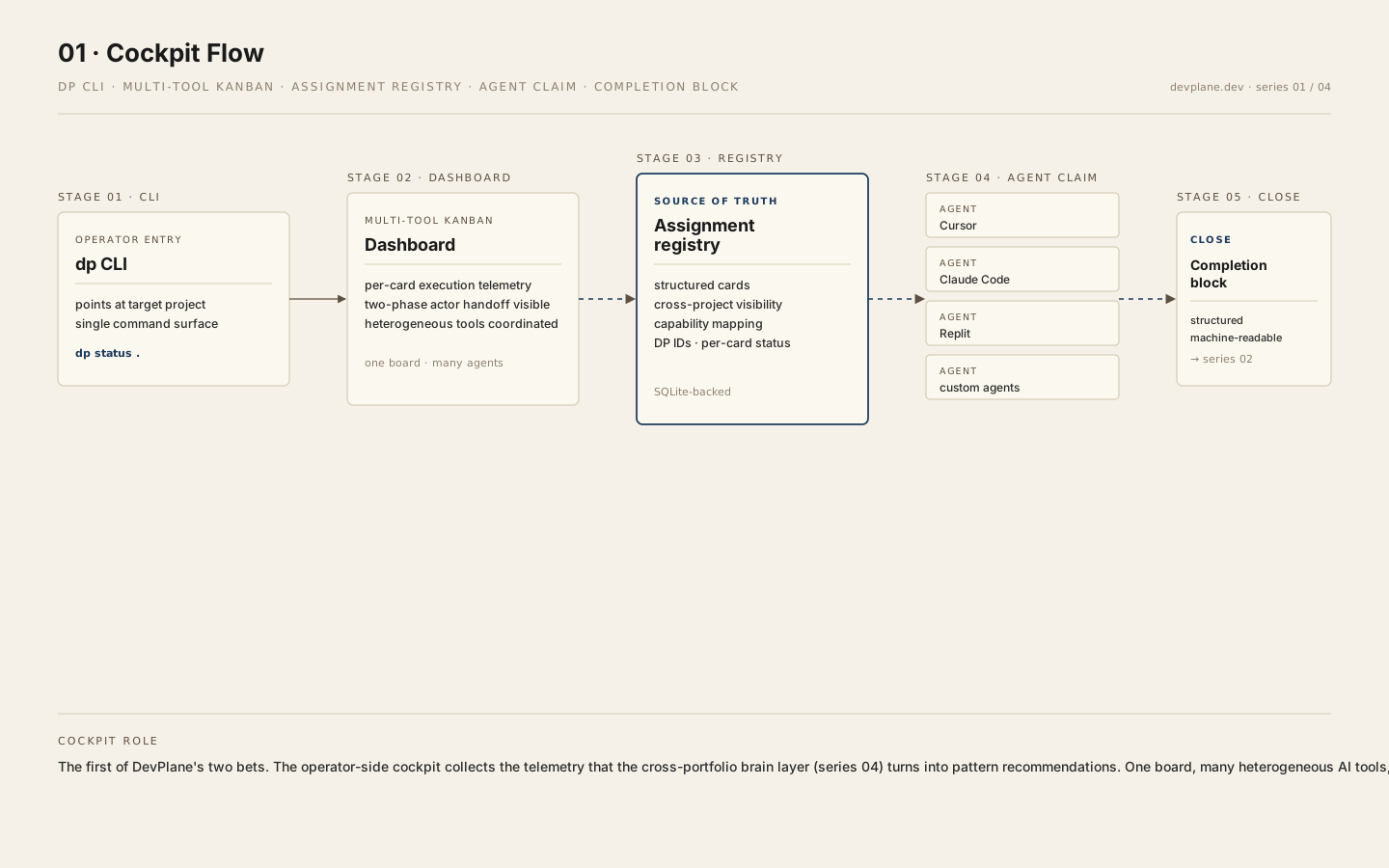
Cockpit flow — dp CLI to multi-tool kanban to assignment registry to agent claim to completion block.
The operator points the `dp` CLI at a target project and the kanban surfaces every card in flight across every tool. The assignment registry is the source of truth — SQLite-backed, structured, cross-project visible. Agents claim cards through the registry: Cursor, Claude Code, Replit, custom agents — all coordinated through one board. The cockpit is the first of DevPlane's two bets, and it collects the telemetry the cross-portfolio brain layer (series 04) turns into pattern recommendations.
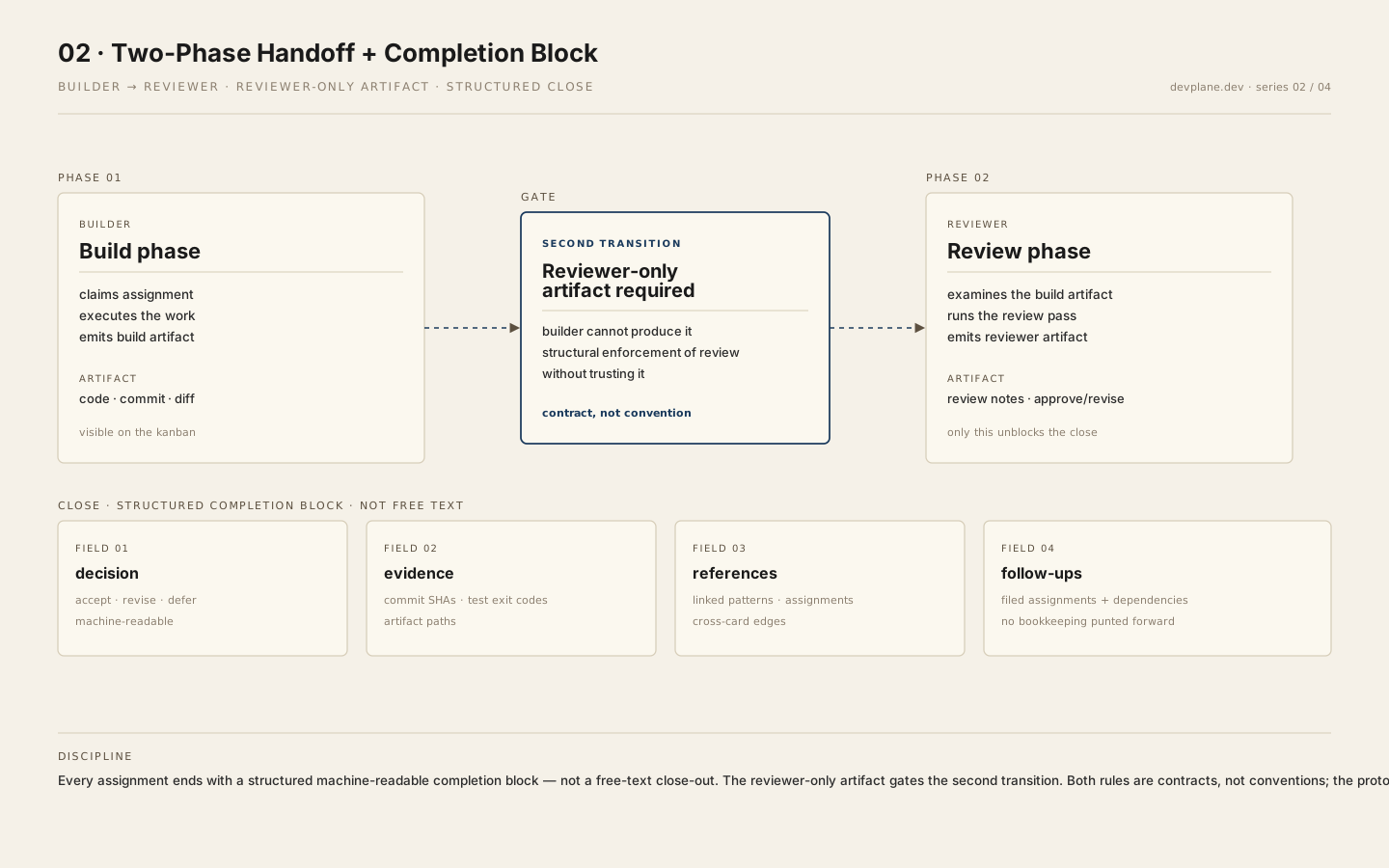
Two-phase actor handoff and structured completion-block protocol.
Builder emits the build artifact; the second transition requires a reviewer-only artifact the builder cannot produce; reviewer runs the pass and emits the review artifact; the card closes with a structured machine-readable completion block carrying decision, evidence, references, and follow-ups. Two rules — the reviewer-only artifact gating the handoff, and structured completion replacing free-text close-out — are the difference between a kanban that is a board and a kanban that is a research instrument. Both are contracts, not conventions.
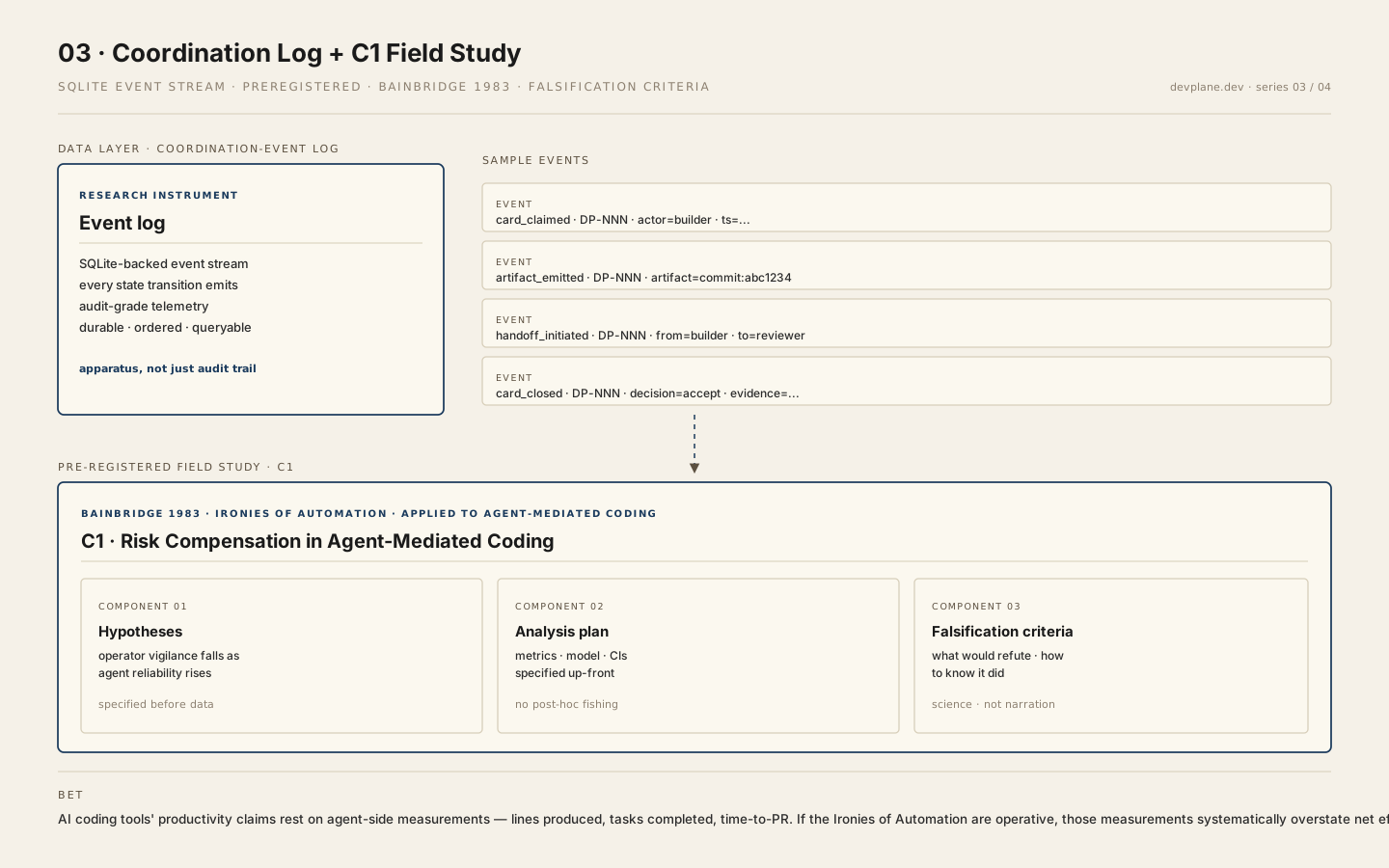
Coordination-event log + C1 risk-compensation field-study apparatus.
Every state transition in the cockpit emits an event into a SQLite-backed coordination-event log. That log is not just an audit trail; it is the apparatus for C1 — a pre-registered field study testing Bainbridge 1983's Ironies of Automation against agent-mediated coding work. Hypotheses, analysis plan, and falsification criteria are specified before data accumulates. The bet underneath is that AI coding tools' productivity claims rest on agent-side measurements that systematically miss what an operator running multiple agents has to do; the cockpit collects the operator-side data, and the study tests the claim. Either way, more honest than what the field has today.
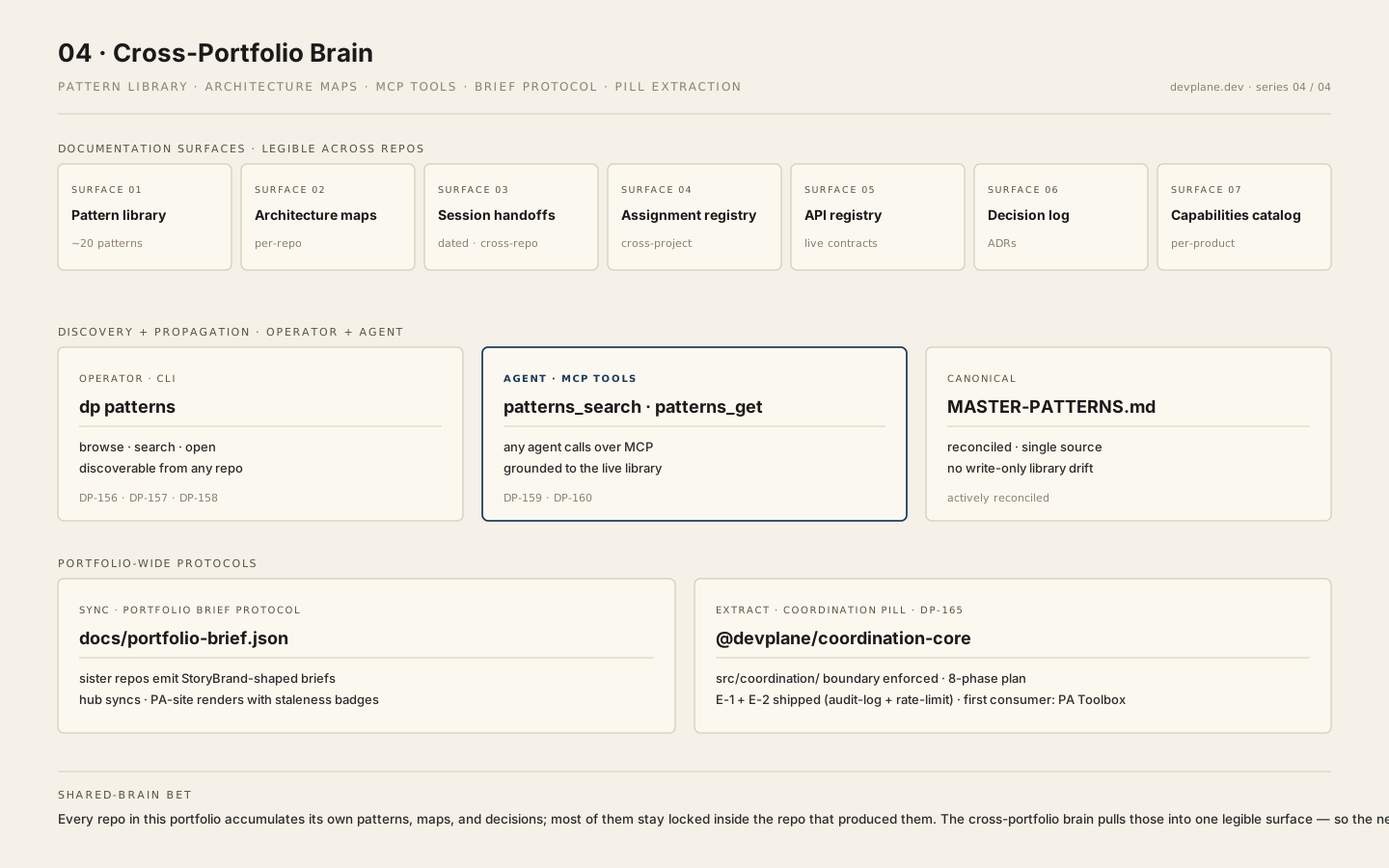
Cross-portfolio brain — pattern library, MCP tools, Brief Protocol, coordination-pill extraction.
Seven documentation surfaces — pattern library, architecture maps, session handoffs, cross-project assignment registry, API registry, decision log, capabilities catalog — are legible across every repo in the portfolio. Propagation works two ways: operators reach the patterns through the `dp patterns` CLI, agents reach them through `devplane_patterns_search` and `devplane_patterns_get` MCP tools, and MASTER-PATTERNS.md is the actively-reconciled canonical surface. The Portfolio Brief Protocol syncs sister-repo briefs into the hub; the coordination-pill extraction (DP-165) carves a no-outside-imports `src/coordination/` boundary toward `@devplane/coordination-core` v0.1.0, with PA Toolbox planned as the first external consumer. The shared-brain bet pays for itself the first time a new product stands on the last one's shoulders instead of rebuilding from scratch.