Namesake↗ namesake.baby
↻ brief 69d ago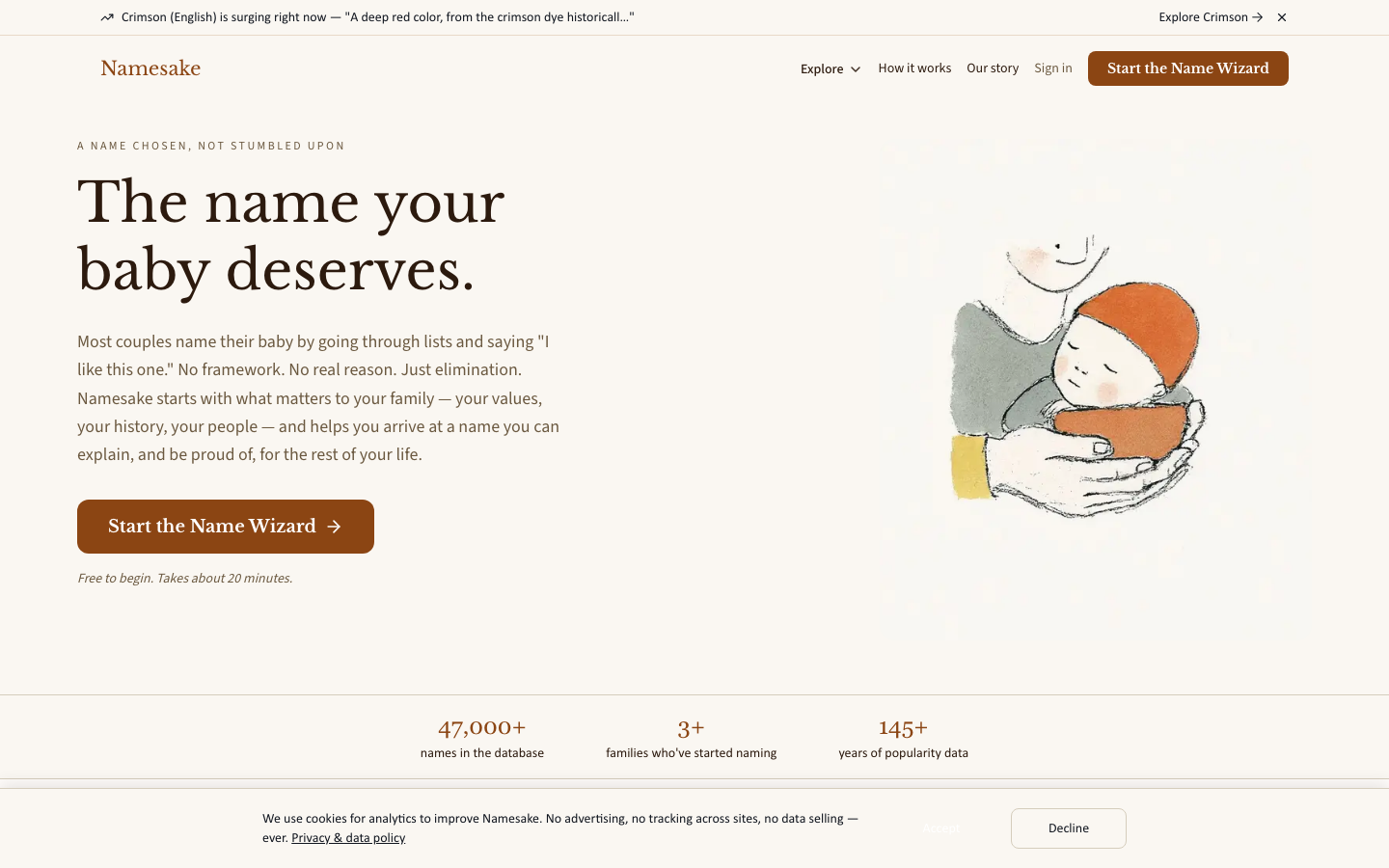
Landing
A name chosen, not stumbled upon. Every baby-naming product helps parents find names; Namesake is the only one that helps them choose one. Built on twenty years of weekly search data, a per-name composite score (SSA stats × LLM-enriched meaning × cultural-event attribution), a tournament-bracket decision UX with village voting, and a cultural-diffusion research apparatus underneath.
- Customer
- Expecting parents who treat naming as one of the highest-stakes irreversible decisions they will make.
- Problem · external
- Most baby-naming products are SEO listicles — they cannot tell you whether a name is rising or fading, cannot attribute a rise to a specific film or character or royal birth, and cannot help two parents converge on a single choice.
- Problem · internal
- The infinite-list feeling — every search returns more names, every name returns more lists, and the decision stays exactly as undecided as it started.
- Problem · philosophical
- Naming a child is one of the few truly irreversible decisions a parent makes; the choice deserves research, structure, and signal, not entertainment dressed up as a product.
- Guide
- Namesake — twenty years of weekly search data, a deterministic per-name composite score (SSA stats × LLM-enriched meaning × cultural-event attribution), and a tournament-bracket UX that forces choosing over browsing.
- Plan
- A wizard captures parents' story, taste, and constraints → the system produces a scored, swipable list → a single-elimination bracket with village voting + shower mode drives convergence on a single name.
- Success
- Two parents converge on one name they both feel right about, with the research behind why it carries the weight it does.
- Failure avoided
- Another listicle scroll that ends with the decision exactly as undecided as it started — and a name chosen by default rather than chosen on purpose.
Most baby-naming products are SEO listicles dressed up as products. They cannot tell you whether a name is currently rising or fading; they cannot attribute the rise (which film, which royal birth, which character); they cannot help two parents converge on a shared decision; and they cannot tell you why one name carries narrative weight and another does not. The decision warrants more than a top-100 list. Nothing on the market treats it that way.
Live product at namesake.baby. $24 one-time tournament unlock — no subscription — that gates the builder, single-elimination bracket UX, village voting, shower mode, and birth reveal. A wizard flow walks parents through their story, taste, and constraints; the system produces a scored, swipable list (the *Namesake score* is a deterministic composite — uniqueness × 0.30 + trend × 0.25 + meaning × 0.20 + feasibility × 0.13 + search × 0.12, percentile-normalized into a 5–95 display range against the dataset). A cultural-intelligence content layer maps name spikes to specific films, shows, and events with attribution drawn from OMDb, TMDb, Wikipedia, and AI synthesis — the definitive record of how popular culture has shaped American baby naming. Visual identity is light-mode taste-grade (Libre Baskerville + Source Sans 3, terracotta and cream palette); profile illustrations are generated through a FLUX pipeline via FAL.
- 01Decision-discipline product framing — the locked positioning is *a name chosen, not stumbled upon*. Every surface is built around helping parents converge on a single name, not browse infinitely.
- 02Tournament-bracket UX — single-elimination naming bracket, village voting, shower mode, and birth reveal as bundled features under a $24 one-time unlock. The bracket forces the choosing-not-browsing motion the positioning names.
- 03Twenty years of weekly search data plus systematic cultural-event attribution. Most naming products show annual SSA rankings; Namesake shows weekly trend velocity with named causal events (the film that landed, the character who became iconic, the royal birth) attached. No competitor has the dataset.
- 04Cultural-diffusion research apparatus — Bass diffusion, Hawkes self-exciting processes, Moran's I, Granger causality, Lieberson null model, phonetic-spillover graphs, variance decomposition. The research surface is mirrored to `/research/namesake/` and is the structural backbone for the network-mediated-adoption book project: same mechanism on a cultural-name corpus that the book argues for on organizational adoption.
- 05Deterministic, percentile-normalized scoring — no LLM-on-render. The Namesake score is computed in a batch rescore script (`npm run recalculate-scores`); the LLM enrichment runs once per name, not per request. Every name's display score is reproducible and bounded; the scoring stays interpretable.
- 06Light-mode executive-tasteful aesthetic — Libre Baskerville serif, terracotta palette, FLUX-pipeline illustrations on the cooler illustration-surface token. The visual register is the audience's; the editorial discipline does not leak.
- 2026-05-17DP-156 / DP-160: REUSABLE_PATTERNS.md now references P233 (Operator-Console Visual Discipline) — codifies palette/typography/density rules for the upcoming admin and curator surfaces (separate aesthetic from the consumer-facing card surface).
- 2026-05-15A-260: Insight cards produced from the predictability-ceiling + Bass / Hawkes / Moran research findings (cultural-diffusion research → consumable cards).
- 2026-05-14PR #1 merged: 2026-05-13 portfolio SOTA snapshot for Namesake (positioning + state-of-the-art capture).
- 2026-05-13Mike-voice reference pointer (PA-017) added to AGENTS.md.
- 2026-05-12A-241..A-247 filed: pull-through from research artifacts to reports/app + phonetic-family product spec.
- ~2026-05-10 — A-237 shipped end-to-end: spelling-variant sensitivity table with consonant guard; queued A-240 Phase 3a g2p quality fix.
- ~2026-05-09 — Production view repair:
name_full.fictional_originerrors fixed; Supabase advisor cleanup queued (A-251 / A-252 / A-253). - Ongoing —
chore(research): nightly PIPELINE_STATUS refresh(GitHub Action; runs daily against the linked Supabase project).
- ·Research pipeline phases on Modal — phonetic-spillover graph, null-model Monte Carlo, Bass / Hawkes / Moran fits, Granger causality, synthetic-control panels. App
baby-namer-research, volumeresearch-data. - ·Phonetic-family product (A-241..A-247) — pulling research artifacts through to in-app reports and a phonetic-family surface.
- ·Tier-2 Google Trends weekly fetch — Modal cron every 12h
:30, prioritized cohort (top scores + |velocity| ≥ 10 movers + SSA surging / rising). - ·Operator/curator UI design pass — P233 visual-discipline applied to dense tables, dashboards, status surfaces (separate from the consumer card aesthetic).
- ·Cultural-intelligence content surface at
/culture/{films,shows,events}— route currently redirects to/namespending hub build.
| Component | Stage | Reuse |
|---|---|---|
Reusable patterns librarydocs/REUSABLE_PATTERNS.md | production | Cross-portfolio reference (DevPlane, sibling repos cite it) |
Operator-Console Visual Discipline (P233)docs/REUSABLE_PATTERNS.md#p233 | production | Pattern doc; consumed by sibling admin/curator UIs |
Composite scoring pattern (Namesake score)lib/ + scripts/recalculate-scores.ts | production | Pattern documented; algorithm locked per docs/PRODUCT.md |
Modal-orchestrated research pipelinecloud/modal_app.py | production | Pattern + working reference for long-running compute off-platform |
Themed-list config + idempotent upsert patternsdocs/REUSABLE_PATTERNS.md | production | Available for reuse across portfolio |
Two structural choices define the repo. First, the research pipeline runs on Modal (app `baby-namer-research`, volume `research-data`, secret `supabase-creds`), not on the laptop and not on Vercel — long-running cultural-diffusion compute (Monte Carlo null models, phonetic-neighbor graphs, Bass / Hawkes / Moran fits, Granger causality) lives in an explicit elsewhere with its own cron schedule and parquet substrate. Second, the Namesake score is deterministic and batch-computed (`npm run recalculate-scores`), never LLM-on-render — LLM enrichment runs once per name into `name_enrichment`, the score is a percentile-normalized composite over fixed weights, and every display number is reproducible from the SSA dataset plus a single enrichment pass. The web app is Next.js 16 App Router + Supabase + Stripe + Anthropic; Vercel deploys from GitHub only (uncommitted work never reaches production), and the canonical positioning is locked at *a name chosen, not stumbled upon*.
Live at https://namesake.baby. Paid product at $24 per tournament unlock — Stripe live. Research surface mirrored to peopleanalyst.com/research/namesake (cultural-diffusion methodology, Bass / Hawkes / Moran reports, predictability-ceiling finding, null-model + phonetic-spillover phases). Cultural-intelligence content strategy laid out for `/culture/{films,shows,events}` SEO surface; route currently redirects to `/names` pending hub build.
Naming a child is high-stakes and irreversible, and most products treat it as entertainment. Namesake exists because the decision warrants the discipline. Underneath the product is a real research bet: twenty years of weekly search data, a spike-detection pipeline, and a cultural-attribution layer that maps name surges to specific cultural events. The dataset is the moat; no competitor is doing this work. The product layer — the wizard, the bracket, the village-voting feature, the bundled $24 unlock — is what turns the data into a decision. Two architectural relationships sit underneath: the research surface is mirrored to PA-site and contributes structural evidence to the network-mediated-adoption book (Bass + Hawkes + Moran + the predictability-ceiling finding work on cultural-name diffusion the same way Centola's lab work runs on organizational behavior); and the player-paradigm UX discipline — taste-grade visual register, paced reveal, decision-shaped surfaces — is the consumer-facing analog of the analytics-grade discipline running across the rest of the portfolio.
Writing
- You Don't Pick the Architecture. You Catch It.
Architecture · Cross-portfolio