Penwright↗ penwright.ink
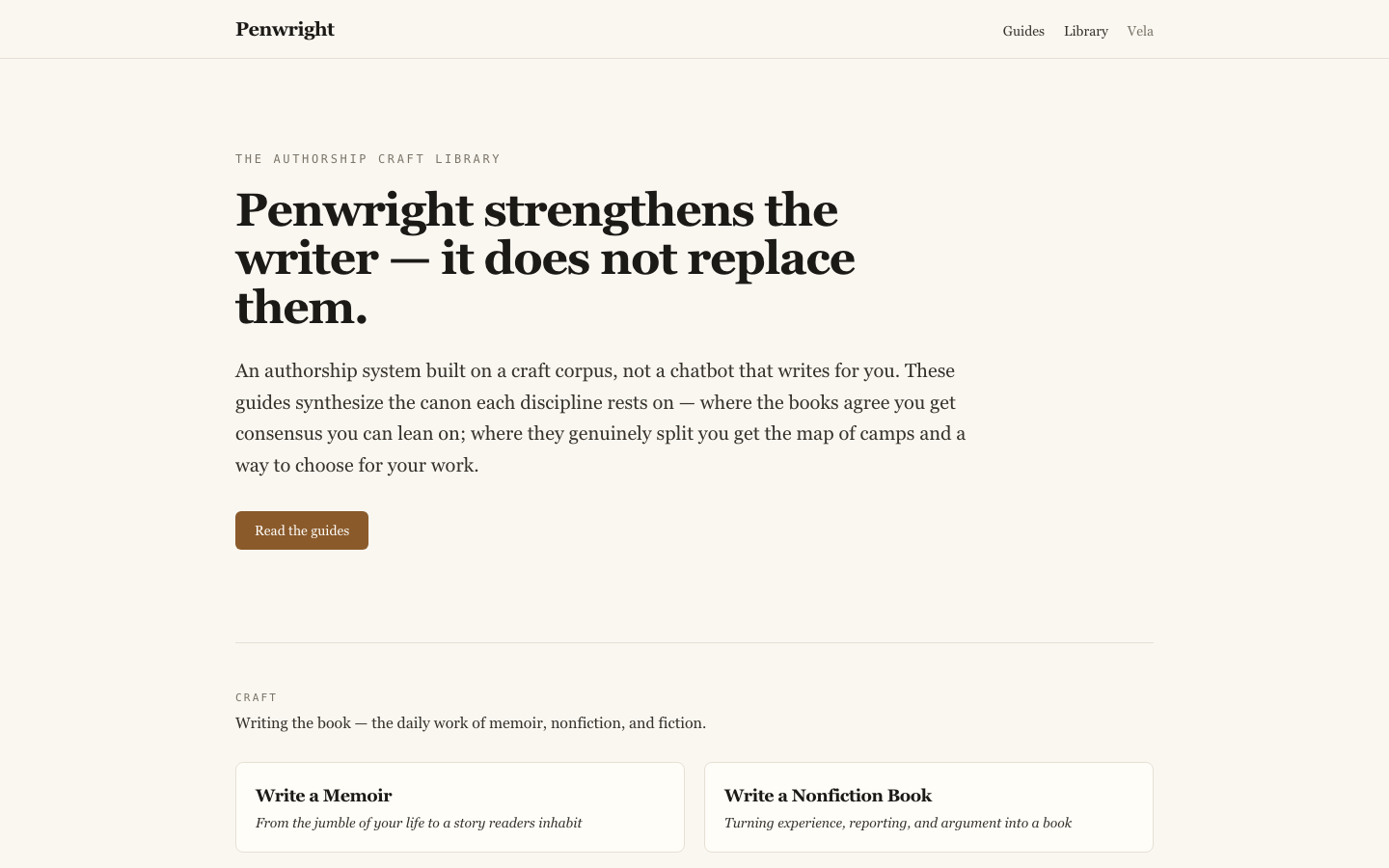
Penwright — the authorship craft library, live on its own domain at penwright.ink.
An AI-augmented authorship system — corpus control, packet-shaped composition, and a measurement framework that asks whether the writer is better with it, than without it, in six months.
Most AI writing tools optimize for output fluency. They make it easier to produce something faster — and that something is often shaped by the model rather than the writer. The longer-term cost (capability erosion, voice flattening, sycophancy spirals, source attribution buried) is barely measured because the field measures what is easy to measure. The result is a generation of tools that look like assistants and act like substitutes.
An authorship environment that inverts the prompt-then-edit pattern. Writers assemble Authorship Packets — intent · structure · key ideas · relevant passages · counterpositions — before the AI is invoked. Corpus selection is explicit: writers choose which sources influence the work rather than inheriting the model's training distribution. The Adaptive Authorship Control Kernel (F-19) is the spine — central registry of skill measurement, intervention, and genre-aware behavior (memoir / nonfiction / fiction never collapsed). The Penwright Measurement Framework — six skill dimensions, six derived indices, three measurement layers, five-step learning loop, and four non-negotiable failure modes — determines whether a session made the writer better. Lives inside Vela's repo (app/labs/penwright/) for now; graduates when the design stabilizes.
- 01Authorship Packet Model — replaces freeform prompting with structured input units; the structure itself is data
- 02Corpus Control Layer — writer selects sources rather than inheriting the LLM's training distribution
- 03Adaptive Authorship Control Kernel (F-19) — central registry of measurement and intervention; genre-aware behavior forks copy + schema enums + prompts + metrics rather than collapsing them
- 04Penwright Measurement Framework — first multi-dimensional measurement system for AI-augmented writing skill development; four non-negotiable failure modes (output-only optimization · over-automation · weak measurement · ignoring genre differences) act as veto
- 05Accumulating named writing-method primitives — Borrowed Architecture (v1.0, 2026-05-12), They Say / I Say (third primitive, v1.1, 2026-05-13). Each is a registered method with structural anatomy + worked examples + anti-patterns, available to the writer as a callable move inside the kernel rather than as advice in a style guide.
- 06Anti-invention constraint — when a structural rhetorical move requires biographical material the user has not supplied, the tool refuses to render rather than confabulating
- 07Writing-craft corpus as the method-reference material — Layer-1 writing-craft books (Carson, Bluets, the recent Cluster A ingestion) tagged for retrieval against method-development sessions, so the kernel cites primary sources when proposing a move, not just trained patterns
- 08Has its own published research program at peopleanalyst.com/research/ai-human-interaction (12-paper Penwright Research Program across three tiers)
Early build inside Vela's repo (app/labs/penwright/). F-03 (Authorship Packet UI MVP) shipped. F-19 (Adaptive Authorship Control Kernel) is the architectural spine; it ships first or in parallel with the first feature. 19 features (F-01..F-19) sequenced across 6 implementation waves. Three named writing-method primitives registered so far (Authorship Packet structure, Borrowed Architecture, They Say / I Say); writing-craft corpus Layer-1 (Carson + Bluets + cohort) ingested as method-reference material. Research program at peopleanalyst.com/research/ai-human-interaction is the public-facing trajectory. Public craft-library surface live on its own domain at penwright.ink.
Penwright exists because the field of AI writing is being measured by output and not by capability. The longitudinal test — better writer with Penwright, than without it, in six months — is unfashionable but load-bearing. The alternative bet — better outputs faster, optimization toward fluency — is the bet most of the field has already taken. Penwright is the bet on the other side: that writers can become more capable inside an AI-augmented environment, and that this can be measured rigorously enough to fail on its own terms. Seven non-negotiable rules in §7 of the vision doc act as the spine for every product decision (don't build generic AI writing features · don't collapse genre distinctions · don't hide source attribution · don't flatten emotional nuance · don't optimize for speed over authorship · don't make AI compliant · don't over-moralize).
Writing
- The Failure Record
Field guide · AI failures