Principia↗ peopleprincipia.com
↻ brief 69d ago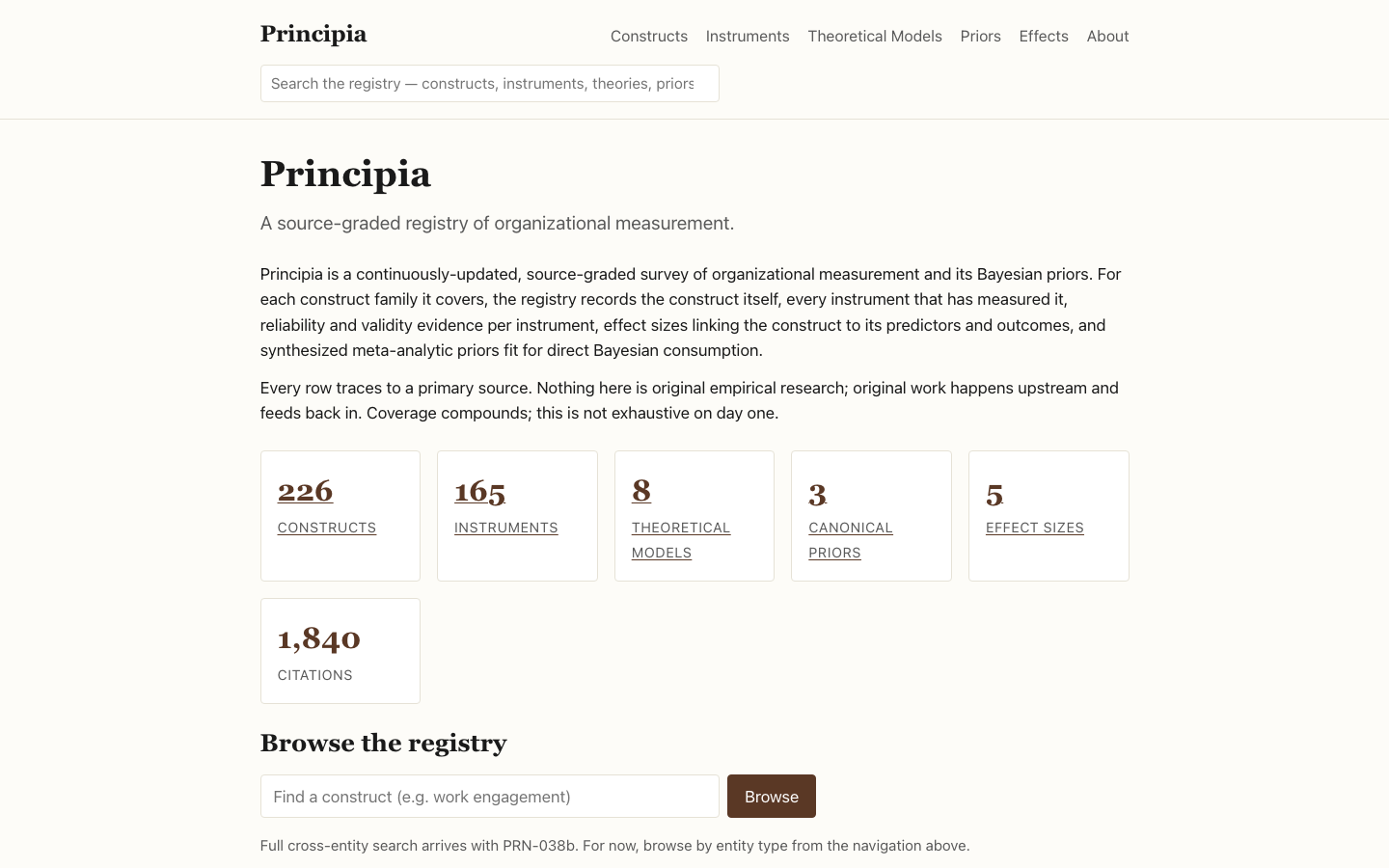
Public reader — the source-graded registry front at peopleprincipia.com: 509 constructs, 874 instruments, 781 canonical priors, 1,040 effect sizes, 8,288 citations.
The continuously-updated, source-graded, citation-verified, Bayesian-prior-bearing registry of organizational science — a survey-not-original-research curation layer that sits on top of CanonicAI's extraction pipelines and feeds canonical priors to the rest of the portfolio over a versioned REST + MCP contract.
- Customer
- Builders, researchers, and operators working on organizational measurement who need a single source-graded place to look up constructs, instruments, reliability/validity evidence, and effect sizes — alongside the People Analytics Platform consuming canonical priors over MCP.
- Problem · external
- The same construct is measured five different ways across five different studies; effect-size tables are scattered through textbook chapters; high-quality instruments get reinvented in low-quality form; and the existing measurement-handbook tradition synthesizes at publication date rather than continuously.
- Problem · internal
- You can't tell whether the engagement number on the dashboard means what the field thinks engagement means, because the literature you'd need to check is fragmented across decades and you don't have a week to assemble it.
- Problem · philosophical
- Load-bearing measurement decisions should be defensibly grounded in the source-graded primary literature, not in the closest survey vendor's marketing copy.
- Guide
- Principia is the continuously-updated, source-graded, citation-verified, Bayesian-prior-bearing registry of organizational science — a survey-not-original-research curation layer that sits on top of meta-factory's extraction pipelines and feeds canonical priors to the rest of the portfolio.
- Plan
- (1) Consume `@measurement/core` as the canonical schema spine, (2) ingest construct-family-by-construct-family with source grading and effect-size tables, (3) expose the registry over a versioned REST + MCP contract so consumers vendor typed reads and don't re-implement.
- Success
- The customer looks up a construct once and sees the instrument inventory, item-level schemas, graded reliability/validity evidence, meta-analytic effect-size table, and the Bayesian prior synthesized from it — with provenance preserved end-to-end.
- Failure avoided
- Measurement decisions made on tertiary summaries, instruments reinvented in degraded form, effect sizes pooled across incomparable studies, and a portfolio of products that each carries its own slightly-drifted definition of the same construct.
The same construct is measured five different ways across five different studies; effect-size tables are scattered through textbook chapters; high-quality instruments get reinvented in low-quality form; and the existing measurement-handbook tradition synthesizes at publication date rather than continuously. You can't tell whether the engagement number on the dashboard means what the field thinks engagement means, because the literature you'd need to check is fragmented across decades and you don't have a week to assemble it. Load-bearing measurement decisions should be defensibly grounded in the source-graded primary literature, not in the closest survey vendor's marketing copy.
Hub-and-spoke around `@people-analyst/measurement-core` — the canonical vocabulary (Construct, Instrument, Item, Measure, Model, EffectSize, Publication, StudyQualityGrade, CanonicalPrior) lives in the shared package; Principia is the canonical registry of rows, not the canonical vocabulary. Tightly coupled with CanonicAI upstream — asset IDs, variable codes, and classification flow forward into the registry; the registry is downstream of extraction, not parallel to it. Public reader UI live at `peopleprincipia.com/registry/*` (PRN-038a–d: scaffold, cross-entity linking, distribution plots, JSON-LD + OG + partitioned sitemap + Vercel Analytics) with the CanonicalTheoreticalModel layer (PRN-037, schema + REST + 8 seed theories), instrument-equivalence networks (PRN-042, 5 engagement-family seeds), validity-decay + MethodologyCritique + cultural sub-priors (PRN-043/044/045), and a construct → "valid & reliable measures" surface (PRN-040). Curator admin console at `/admin/*` (PRN-029): citations, queues, watchlists, plus a promote-effect-size CLI (PRN-030, D4-compliant write path) and novelty-verification queue (PRN-032). VoI as a REST endpoint (PRN-046) plus an intervention library (PRN-047). Book-build orchestrator (PRN-041a) with XeLaTeX + HTML5 + APA-7 CSL templates, against the "Principia of Organization Measurement" outline (PRN-041). As of 2026-07 the registry is live and broad: 509 constructs, 874 instruments, 1,040 meta-analytic DOI-backed effect sizes, 781 synthesized Bayesian priors, 116 HR metrics, 8 canonical theoretical models, and 8,288 citations — grouped into domain families via a non-destructive taxonomy overlay (PRN-134). New capability layers landed: a methods API + research-methods wizards (PRN-101/102 — the evidence + assumption→remedy knowledge base behind a study-designer and analysis-wizard), article deep-extraction (PRN-131 — open-access PDF → results-table effects → curator-gated proposals), and study-design classification across an 8-facet taxonomy rendered as X–O–R / research-flow diagrams (PRN-095). Curator-gated throughout; nothing fabricated.
- 01Continuous citation-verified curation, not point-in-time handbook synthesis — the registry refreshes as the literature does, with provenance preserved end-to-end.
- 02Source grading as a first-class field on every claim — StudyQualityGrade lives in the schema, so downstream consumers can weight evidence rather than treat all citations equally.
- 03Bayesian-prior bearing — canonical priors are a first-class output of the registry, not a downstream interpretation; the rest of the portfolio vendors typed priors instead of re-fitting from scratch. First live CanonicalPrior is engagement → task performance, synthesized from Corbeanu 2023 + Neuber 2021 (k=3); Mazzetti 2023 promoted engagement → satisfaction (r=.60) + engagement → commitment (r=.63); Christian, Garza & Slaughter 2011 resynthesizes engagement → performance.
- 04CanonicalTheoreticalModel layer as Pillar-1 — schema + handlers + REST + 8 seed theories (PRN-037), with instrument-equivalence networks (PRN-042) linking measures across nominally-distinct instruments. The vocabulary recognizes that the same construct gets measured by different instruments that should be calibrated against each other, not treated as separate variables.
- 05Validity-decay + MethodologyCritique + cultural sub-priors (PRN-043/044/045) — explicit modeling of how evidence ages, how methodology shapes finding strength, and how priors differ by cultural context. The registry doesn't pretend universality where the literature doesn't support it.
- 06Survey-not-original-research positioning — Principia does not run new studies; it curates the existing literature into a legible, queryable, source-graded registry.
- 07MCP-native distribution — the registry is consumable by AI agents over Model Context Protocol from day one, not via a UI someone else's product sits on top of. VoI exposed as a single-tuple Bayesian-prior shortcut at `/api/v1/voi` for callers that just need the next-best-measurement decision.
- 08Book-build orchestrator (PRN-041a) — the registry contents compose into "The Principia of Organization Measurement" via directive expansion + appendix auto-builders + XeLaTeX/HTML5/APA-7 templates. The registry is its own primary source.
- 2026-04-30Initial scaffold v1: research surface, AGENTS, methodology, roadmap (
17190d5) - 2026-05-06Mike-voice reference pointer (PA-017) (
fbedaa6) - 2026-05-11PRN-001..008 assignment queue + first-wave research entries (
d7992ed) - 2026-05-13Portfolio SOTA snapshot landed in
docs/SNAPSHOTS/2026-05-13-snapshot.md(2b3ffd1, PR #1 merged) - 2026-05-18Canonical engineering + portfolio spec v0.1 landed (
docs/specification/SPEC.md) with PRN-010..015 engineering queue (3ad2b25) - 2026-05-19ASN-1013 closed: consume
@measurement/coreas the schema spine (e839d30); tight-coupling-with-meta-factory codified in AGENTS.md (da4c7e8) - 2026-05-19PRN-010 scaffolded
packages/core+packages/registry; PRN-011 consumed Deltas 4-5 from@measurement/corev0.2 (2d9f144,61e10bf) - 2026-05-19PRN-013 JSON-file registry store +
CanonicalVariableresolver (6b66e84) - 2026-05-19PRN-012 (partial) engagement-family ingest adapters: 147 source constructs → 68 canonical variables, 38 instruments, 72 citations (
aa98246) - 2026-05-19Bayesian-prior reframe: Deltas 6-9 + continuous-loop + 12 new assignments (
d01d3ab) - 2026-05-19PRN-014 MCP tools +
apps/webNext.js scaffold +/api/health+/api/mcp(37d6d90) - 2026-05-19PRN-014c follow-ons: namespace rename to
@people-analyst/measurement-core@^0.5.1,.npmrcfor Vercel build root (8d3e2de,7803b89)
- ·PRN-014c —
apps/webVercel deploy so/api/healthreturns 200 from a public URL (open PRrefactor/measurement-core-namespace-rename); unblocks toolbox PAT-114 coming-soon → live flip - ·PRN-012 full — extend ingest beyond engagement to Tier 1 families (job satisfaction, organizational commitment, burnout, psychological safety) per
docs/research/PROGRAM.mdorder - ·PRN-014b + PRN-015 — full REST surface (
GET /constructs,/instruments,/effects) + per-consumer auth keys + audit-table upgrade beyond JSON-line - ·PRN-019 + PRN-020 — continuous-loop infrastructure:
LiteratureMonitorentity + watchlist scheduler +EnrichmentJobqueue + worker loop (Deltas 8-9) - ·PRN-021 — Bayesian-prior synthesis engine:
EffectSize[]→CanonicalPriorrandom-effects meta-analysis, quality-weighted, provenance-preserving - ·PRN-001..004 — audience-tier writeups (general / peer-review / engineering / product) for
peopleanalyst.com/research/principia/ - ·PRN-005 — engagement-family construct survey (Tier 1 proof-of-method), gated on schema landing (now unblocked by ASN-1013 close)
| Component | Stage | Reuse |
|---|---|---|
@principia/registry JSON-file store + resolverpackages/registry/ | early-build | available for reuse; consumed in-process by apps/web and the smoke harness |
MCP gateway (makeMcpGateway, computeHealth)packages/registry/src/ | early-build | exposed at apps/web/api/mcp; intended consumers are toolbox principia-connector + future agents |
apps/web Next.js public surfaceapps/web/ | early-build | Principia's Phase 3 host (peopleprincipia.com); ships /api/health + /api/mcp ahead of editorial pages |
Engagement-family ingest adapterspackages/registry/src/ (PRN-012) | early-build | template for Tier 1 family ingest; not yet generalized |
Principia is structurally a curation layer that sits on top of meta-factory's extraction pipelines and below the People Analytics Platform's analytical surfaces. Three structural commitments define the shape. First, hub-and-spoke against `@measurement/core` — the canonical vocabulary (`Construct`, `Instrument`, `Item`, `Measure`, `Model`, `EffectSize`, `Publication`, `StudyQualityGrade`, `CanonicalPrior`) lives in the shared package, and Principia is the canonical registry of rows, not the canonical vocabulary. Second, tight coupling with meta-factory — asset IDs, variable codes, and classification dimensions are consumed verbatim from meta-factory's metadata coding; Principia does not invent parallel schemes and does not run parallel extraction. Third, two-shaped output — the same underlying rows render as a book manuscript and as a queryable database, exposed over a versioned REST + MCP contract so consumers vendor typed reads instead of re-implementing. The repo itself is a TypeScript monorepo with `packages/core`, `packages/registry`, and `apps/web` (Next.js 16); the markdown research surface (`docs/research/`) and the engineering scaffold ship in the same git history because they describe two surfaces of one project, separated only by audience.
Live at peopleprincipia.com. Public reader UI built out 2026-05-13 → 2026-05-21 (PRN-038a–d: scaffold + cross-entity linking + distribution plots + SEO/JSON-LD/sitemap/Analytics). First live CanonicalPrior shipped (engagement → task performance, k=3, from Corbeanu 2023 + Neuber 2021); engagement-survey v1.1 promoted 8 FILL markers to live priors. CanonicalTheoreticalModel layer + 8 seed theories (PRN-037), instrument-equivalence networks + 5 seeds (PRN-042), validity-decay / MethodologyCritique / cultural sub-priors (PRN-043/044/045), valid-&-reliable measures surface (PRN-040), VoI REST + intervention library (PRN-046/047), curator admin console at `/admin/*` (PRN-029), and the book-build orchestrator with XeLaTeX/HTML5/APA-7 templates (PRN-041/041a) all live. Hub-and-spoke against `@people-analyst/measurement-core` (renamed from `@measurement/core` 2026-05-19) is the structural commitment that keeps the vocabulary canonical across the portfolio; `@people-analyst/measurement-core` is now consumed by the People Analytics Toolbox over the canonical-priors REST contract.
Principia exists because measurement is where every people analytics product either earns its credibility or quietly loses it. The discipline has decades of accumulated knowledge about how to measure organizational constructs defensibly — and most of it sits behind paywalls, scattered across textbook chapters, or buried in supplementary tables. The result is that load-bearing measurement decisions get made on tertiary summaries, instruments get reinvented in degraded form, and the same construct ends up measured five different ways across the same vendor's product line. Principia's bet is that the curation layer — survey-not-original-research, continuously updated, citation-verified, source-graded, exposed over a typed contract — is the missing primitive that lets the rest of the portfolio compose against grounded measurement rather than re-deriving it. The hub-and-spoke discipline against `@people-analyst/measurement-core` is the architectural enforcement: the vocabulary stays canonical, the registry stays downstream of extraction, and every consumer vendors typed reads rather than carrying its own slightly-drifted definition of the same construct.
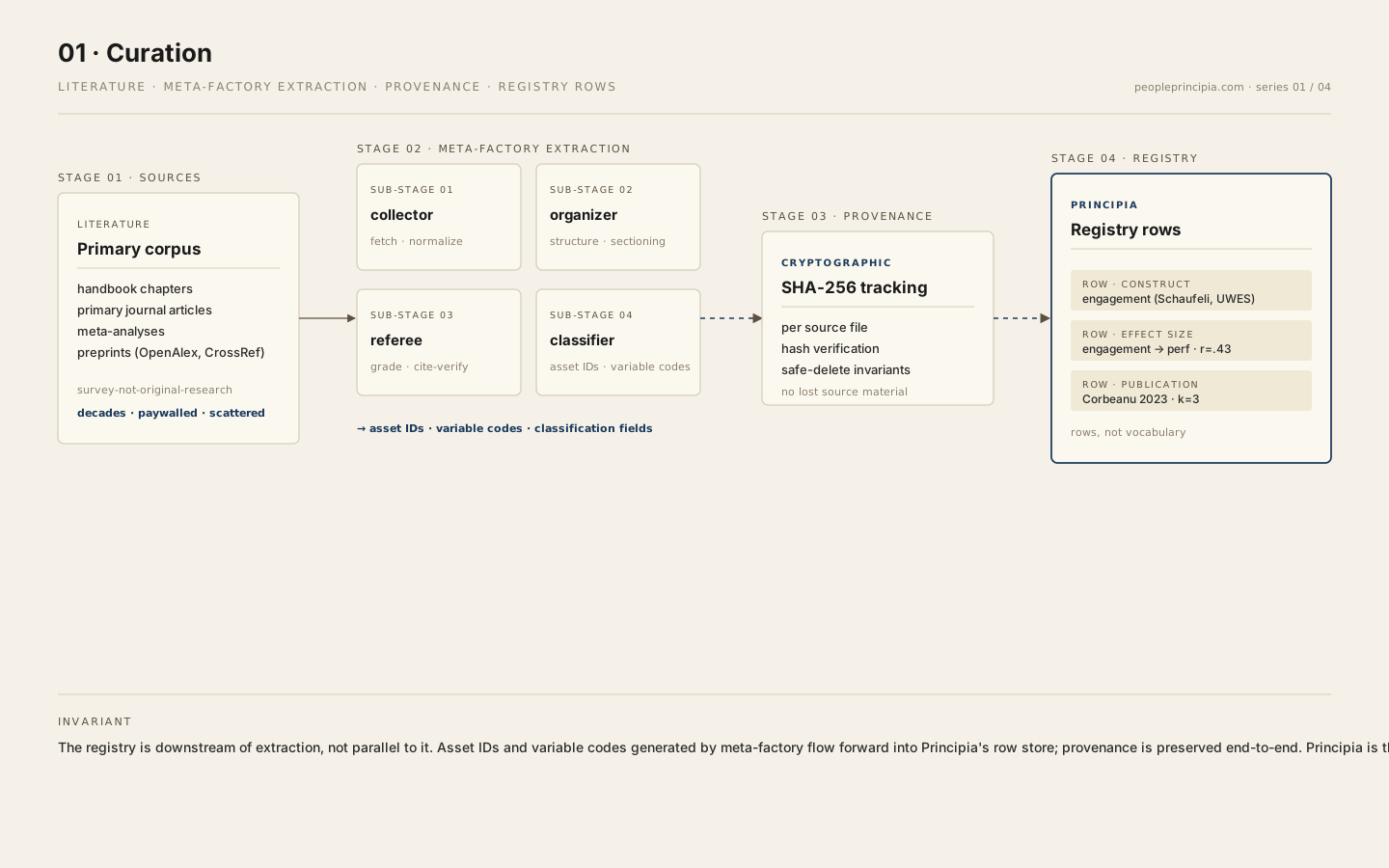
Curation — source literature flows through CanonicAI extraction into registry rows.
Handbook chapters, primary journal articles, meta-analyses, and OpenAlex / CrossRef preprints flow into the CanonicAI pipeline — collector, organizer, referee, classifier — and exit as asset IDs, variable codes, and classification fields. SHA-256 tracks every source file with safe-delete invariants requiring hash verification before any local removal; the system cannot lose source material to a careless deletion. The registry is downstream of extraction, not parallel to it. Principia is the canonical registry of rows; the canonical vocabulary lives elsewhere.
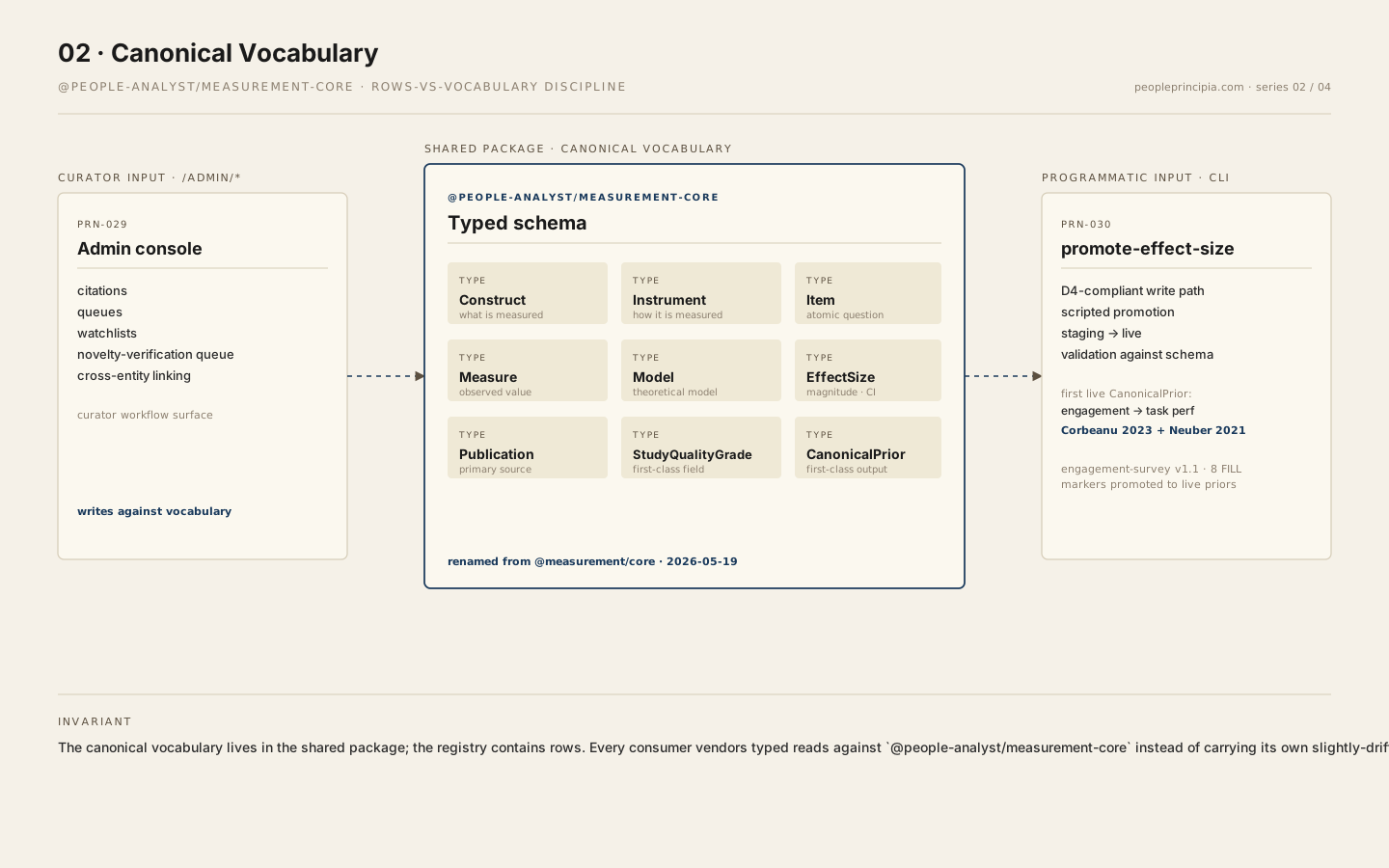
Canonical vocabulary — @people-analyst/measurement-core defines the types every consumer vendors.
The vocabulary lives in `@people-analyst/measurement-core` (renamed from `@measurement/core` on 2026-05-19): Construct, Instrument, Item, Measure, Model, EffectSize, Publication, StudyQualityGrade, CanonicalPrior. The curator admin console at /admin/* (citations, queues, watchlists, novelty verification) and the D4-compliant promote-effect-size CLI both write into the registry against the shared types. The rows-vs-vocabulary discipline is what keeps measurement comparable across the portfolio — every consumer vendors typed reads instead of carrying its own slightly-drifted definition of the same construct.
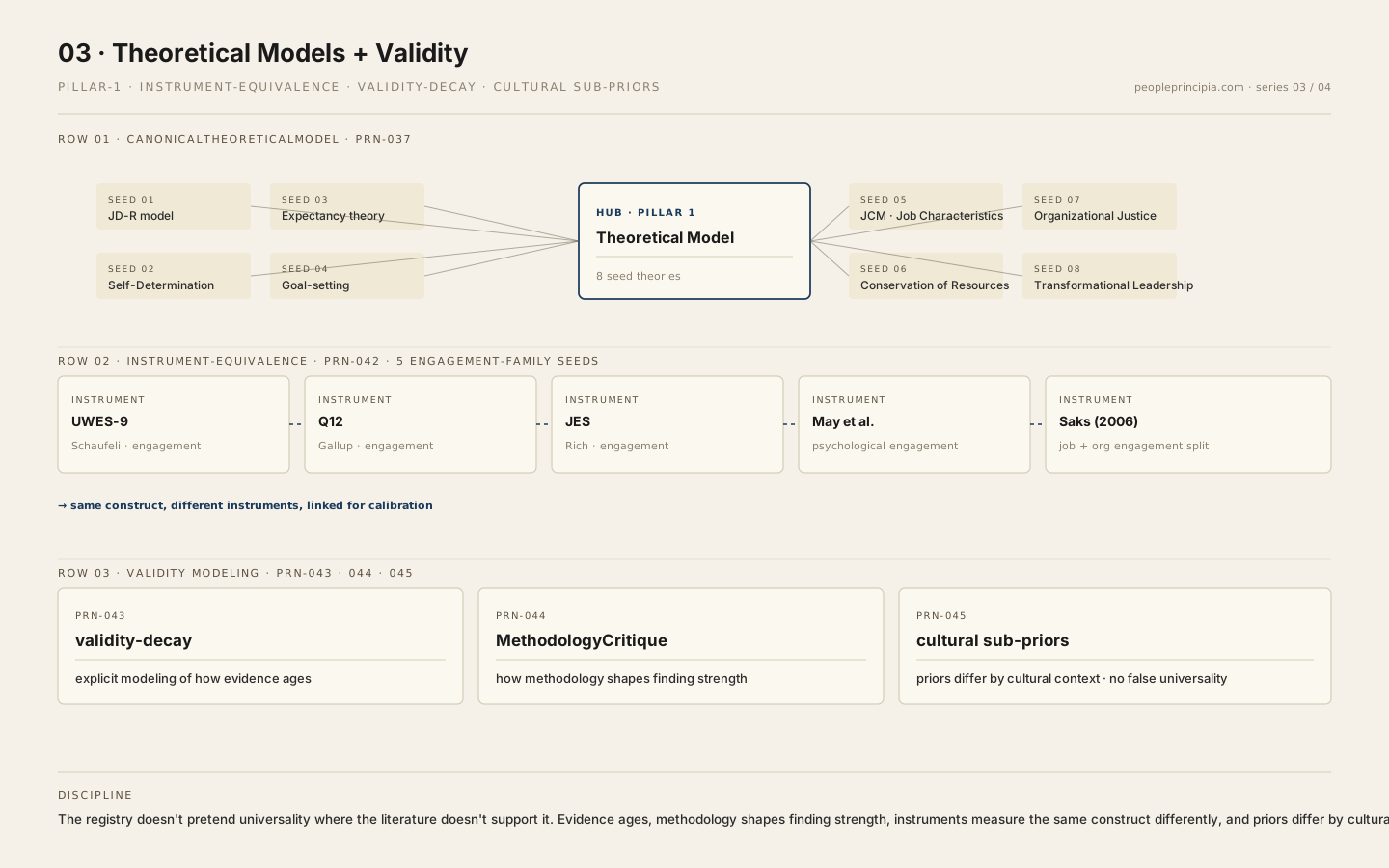
Theoretical models + validity layer — Pillar-1 modeling depth across three primitives.
The CanonicalTheoreticalModel layer (PRN-037) ships eight seed theories — JD-R, Self-Determination, Expectancy, Goal-setting, Job Characteristics, Conservation of Resources, Organizational Justice, Transformational Leadership — and the instrument-equivalence networks (PRN-042) link the five engagement-family seeds (UWES, Q12, JES, May et al., Saks 2006) because the same construct gets measured by different instruments that should be calibrated against each other. Validity-decay (PRN-043), MethodologyCritique (PRN-044), and cultural sub-priors (PRN-045) model how evidence ages, how methodology shapes finding strength, and how priors differ by cultural context. The registry doesn't pretend universality where the literature doesn't support it.
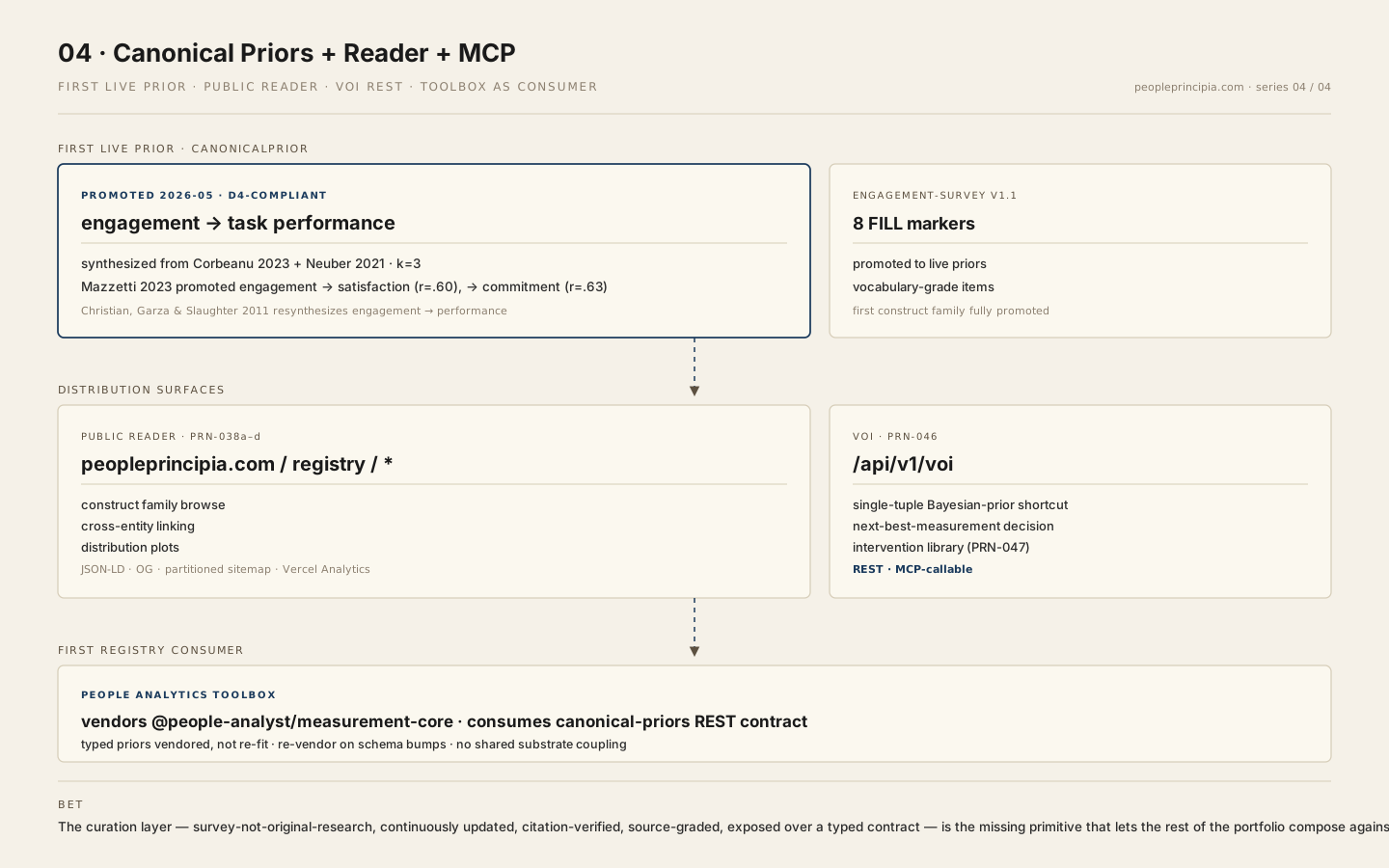
Canonical priors + public reader + MCP — first live prior, VoI REST, toolbox as consumer.
The first live CanonicalPrior — engagement → task performance, k=3, synthesized from Corbeanu 2023 and Neuber 2021 — is promoted; engagement-survey v1.1 has eight FILL markers live; Mazzetti 2023 promoted engagement → satisfaction (r=.60) and engagement → commitment (r=.63). The public reader at peopleprincipia.com/registry/* (PRN-038a–d) carries construct-family browse, cross-entity linking, and distribution plots; VoI is exposed at /api/v1/voi for single-tuple Bayesian-prior shortcuts and is MCP-callable. The People Analytics Toolbox vendors `@people-analyst/measurement-core` and consumes the canonical-priors REST contract — typed priors vendored, not re-fit from scratch.
Writing
- Everything Is Already Known, But Almost Nobody Who Needs to Know, Knows It
AI–human interaction · what's knowable
- The Pay You Can't Explain
Strategy · explaining pay
- Moneyball Never Made It to Work
Methodology · pricing without an outcome
- An Occupation Is Not a Job
Methodology · units & aggregation
- The Turnaround That Wasn't
Methodology · regression to the mean
- People Analytics Is Not Data Science for HR
Corpus analysis · the four-S thesis