Stepcode↗ stepcode.dev
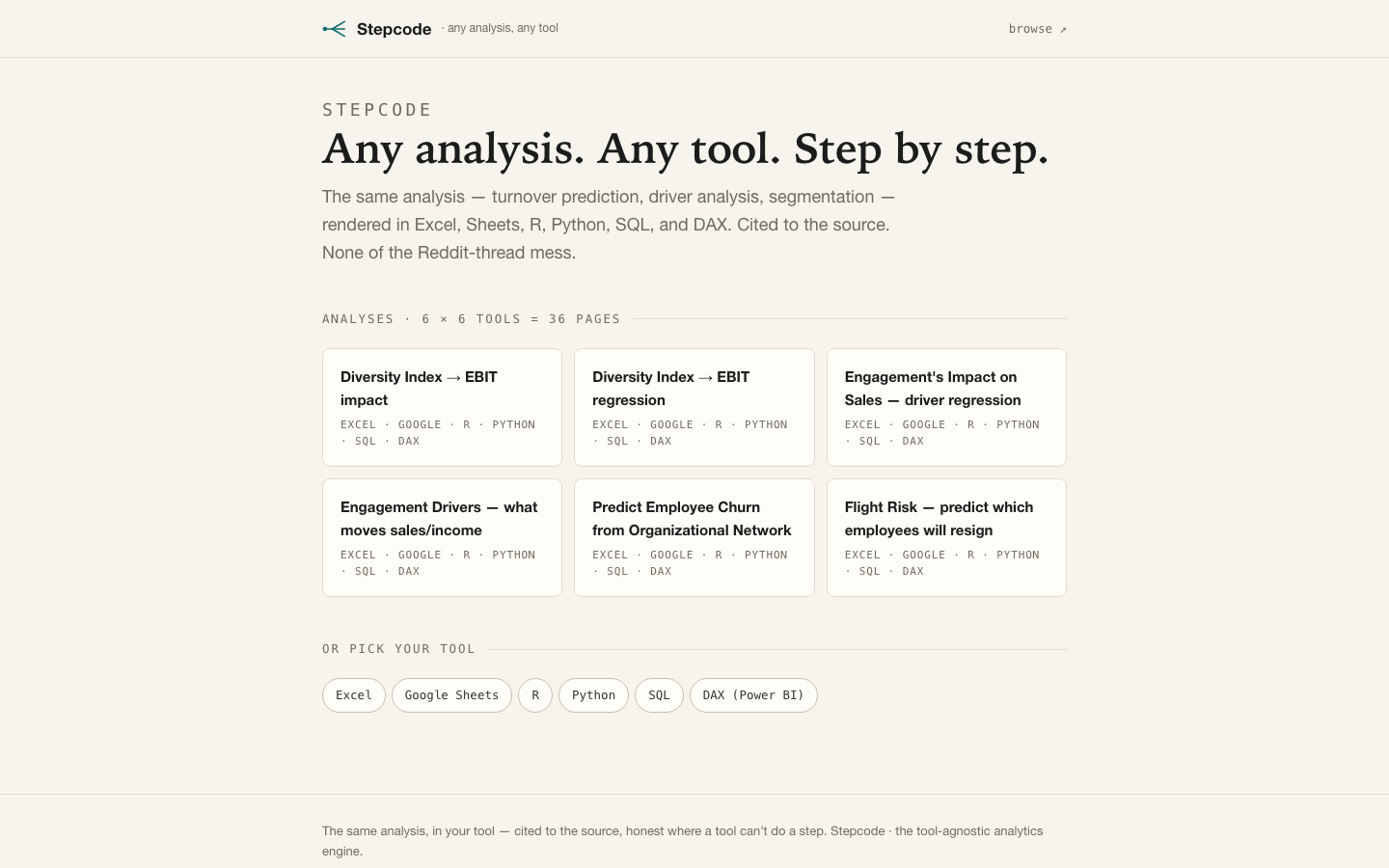
Stepcode — any analysis, any tool, step by step: 6 analyses x 6 tools, cited to the source.
The same analysis, in whatever tool your organization actually runs — turnover prediction, driver regression, segmentation, rendered step by step in Excel, Sheets, R, Python, SQL and DAX, cited to the source.
Knowing the method is not the bottleneck. Executing it in a specific tool is — and the help available for that is a fragmented mess of forum threads, half-right answers, and tutorials that stop before the part you were stuck on. So a correct analysis gets downgraded to whatever the analyst could figure out how to run.
Live at stepcode.dev: an (analysis × tool) grid — six analyses × six tools, 36 pages — produced deterministically from the CanonicAI engine against a governed content contract, not hand-written per cell. Each page walks the steps in that tool, cites its source, and says plainly where a tool cannot do a step rather than faking it.
- 01Analysis and tool as separate axes. Write the analysis once, render it per tool — which is why the grid grows multiplicatively instead of one tutorial at a time.
- 02Honest about tool limits. A page that says 'Excel cannot do this step, here is the closest defensible substitute' is more useful than one that pretends, and it is the thing forum answers never do.
- 03Governed, not authored. Pages regenerate through a content gate against a versioned contract, so the whole grid moves when the method does — the same production discipline as the guides.
Live at stepcode.dev with the 36-cell grid rendering. The forward path is SC-RUN — the same step sequence executed against your own data rather than described — which turns a how-to surface into a service.
Stepcode is the tool axis of the same argument the guides make on the knowledge axis: the method is already known, and what stops people is reaching it. Here the barrier is not a book nobody has time for — it is a spreadsheet nobody has shown them how to drive.