Vela↗ vela.study
↻ brief 69d ago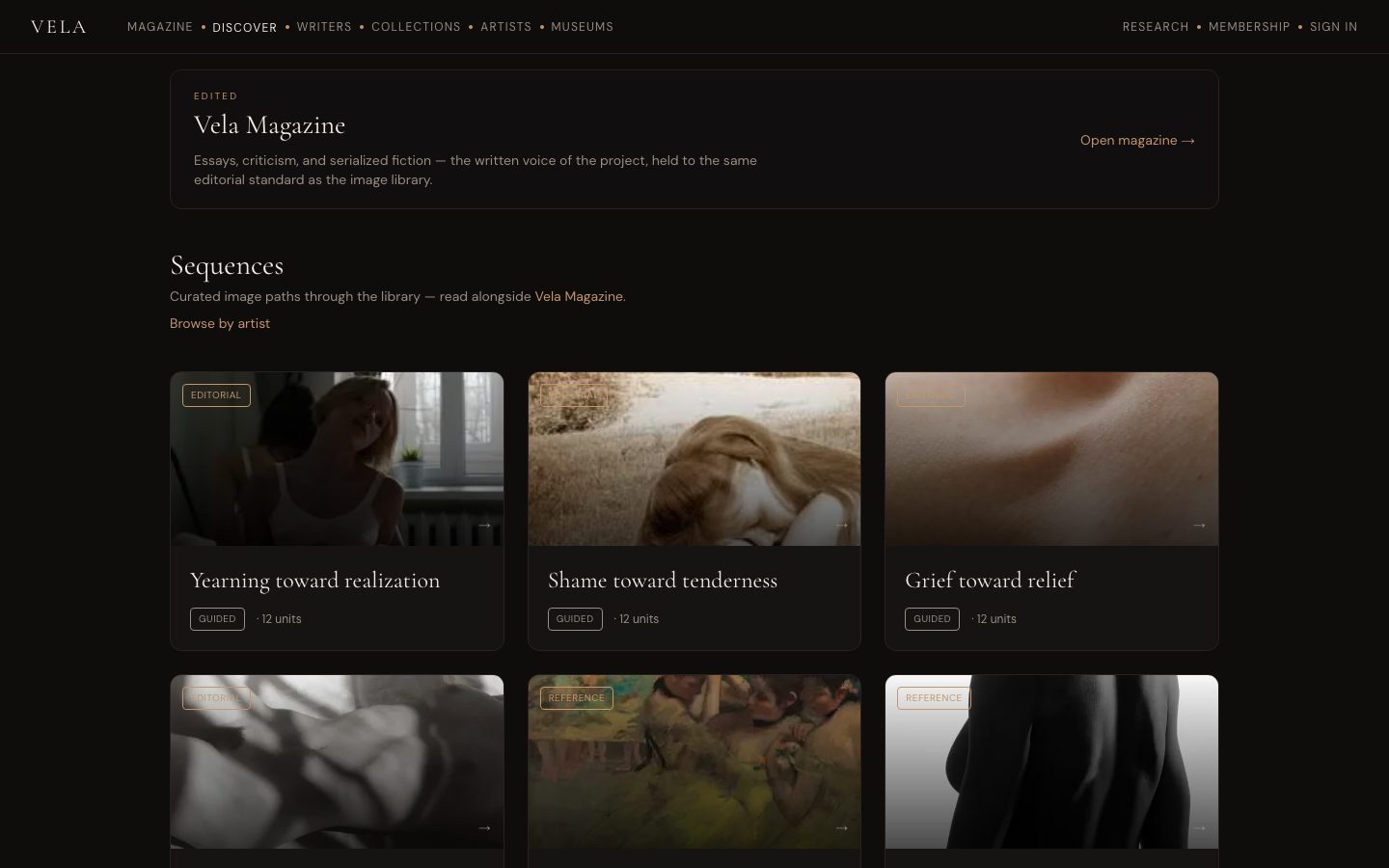
Landing — magazine + sequences
A study of being human, read through four lenses — figurative art and the museum traditions, the vocabulary of emotion, literature (including the religious and contemplative inheritance), and the behavioral science of how people form, feel, and become. A magazine — written primarily by AI from that corpus, edited by humans and shaped by reader feedback — weaves them; adaptive intelligence learns how each reader moves through the material. The figurative-art player is the room a reader can enter first — one dimension positioned in a much broader project, all of it pointed at one work: helping people replace the belief-rooted thoughts and emotional patterns that work against their lives and communities with ones that work for them.
- Customer
- Adults who want disciplined, taste-driven encounters with figurative art and longform editorial work — and the research participants who help calibrate the underlying instruments.
- Problem · external
- Image platforms flatten taste into engagement metrics; editorial platforms publish on calendars rather than to readers. Neither produces a reading rhythm.
- Problem · internal
- The feeling of having nowhere to take a real response to a real image or a heavy piece of writing — no place that takes the response seriously and lets it shape what comes next.
- Problem · philosophical
- Taste should compound. Editorial work should meet a reader where they are. Both depend on adaptive measurement underneath, and almost no consumer surface treats measurement that way.
- Guide
- A contemplative platform with a Reincarnation engine (per-reader desire scoring with adaptive measurement and visual-rhyme sequencing), a five-layer Written System paced per-reader, and museum-grade attribution discipline carrying the whole stack.
- Plan
- Read the magazine on your pacing. Rate images at /play; the engine learns your taste. Participate in /study if the science underneath interests you. Pay $12/mo if you want to support it.
- Success
- The reader's magazine begins when they arrive, not on a calendar. Taste compounds. Heavy material is met with a substrate that knows how to hold it.
- Failure avoided
- Avoids the algorithmic-feed register that flattens taste, the gatekept-museum register that excludes the response, and the calendar-magazine register that publishes regardless of who's reading.
Image platforms either flatten taste into engagement metrics or hide behind gatekeepers. Editorial platforms publish on calendars rather than to readers. Neither produces a reading rhythm. Neither learns from you. And underneath the platform-shape problem sits a materials problem: the things that have always taught us what it is to be human — figurative art, longform writing, the religious and contemplative traditions, emotional engagement, association with others, the act of making something rather than only consuming it — sit scattered across a world that increasingly feels like its opposite. Vela is built on the bet that a single adaptive layer can compose them — taste-driven figurative discovery, longform editorial work, and the move from observing others' art to making one's own art that can carry meaning (Penwright today; other forms of authored response next) — when adaptive measurement runs underneath.
385 active works pulled from museum APIs (ARTIC, Met, BnF, Smithsonian, Europeana) under full attribution and license discipline. The Reincarnation engine learns per-reader desire and pool composition across visual rhyme and emotional register; first production batch shipped. A five-layer Written System — analytical essays, Mosaic pieces (1,353-passage testimony corpus), fiction, audio readings, and submissions — paced per-user (each reader's magazine begins when they arrive, not on a calendar). The Narrative Intelligence Platform generalizes the Mosaic engine into a three-domain spine (lived / fiction / research) with five admin surfaces deployed (Dashboard · Sources · Excerpt Review · Quote Explorer · Insight Workbench · Guide Builder). Artist Studies as the flagship editorial arc pattern — Warhol shipped (10 ASNs, Virtual Docent extension, Pittsburgh walking tour, figures-introduction pass in ASN-1354); Schiele, Klimt, and Sargent staged. Emotion-arc magazine tentpoles continuing: ASN-1355 "On Yearning" (Emotion Guide #5), ASN-1357 "The Emotion You Cannot Name." Penwright lives at /labs/penwright (F-03 Authorship Packet UI MVP shipped; F-19 Adaptive Authorship Control Kernel is the spine; *They Say / I Say* method registered as the third primitive 2026-05-13). New 2026-05 Vela-side sub-surfaces: **Penwright Pennebaker Exercise Studio** (ASN-1349 + Studio diagnostic v1 in ASN-1352, per-day + per-session views over `penwright_studio_sessions`), **FRAME-REFRAME triage instrument** (ASN-1340, partial-ship), and a **Bible-translation project** (Phase 1 workspace + acquisition list). Literature source adapters added (OpenAlex, CrossRef, Scholar) — new research-acquisition capability. Editorial Office: Writer's Desk for 1:1 with each writer; The Office for multi-writer convening with round-2 react. Derivative Pipeline (unlicensed → Vela-licensed, with transformation-distance scoring) live. Stripe membership in live mode. Preregistered research program at /study with consent-gated session, instrument-validation cohort, and dissertation-track scaffolds for RQ1–RQ4.
- 01Reincarnation engine: per-user desire scoring with RID/SID adaptive measurement and visual-rhyme sequencing — the secret sauce, treated as scientific instrument under formal scrutiny (math spec, segmentation explorer, replay pipeline, instrument-validation cohort)
- 02Library as a queryable corpus (2026-05-29) — every book read along the four universal axes (sex / work / learning / religion) plus emotion as actual coordinates, with theme-anchored signature passages, captured as per-book extraction cards. One corpus serves four uses: reader discovery (filters / search / wizards / pairings / "material that resonates with you"), editorial weaving, Penwright, and book-projects-as-queries — God and Work and Bible-as-proto-sociology become retrievals over the corpus, not from-scratch research. 79 cards + 5 genre collections live; the cross-genre God-and-Work query returns its source set across genres.
- 03Behavioral science as a public encyclopedic lens (vision 2026-05-31) — not pop-psych takes but the field canvassed: history, great theories, and classic studies (the stories — Milgram, the Stanford prison, Robbers Cave), each carrying a "how we know it's true (or not)" evidence layer, plus a multi-lens primitive that reads the same phenomenon through psychology vs sociology vs social psychology and names the tension rather than papering it over. The Science leg of the Four-S frame made public — aimed squarely at the overconfident business/technologist reader who doesn't know what they don't know. Renders three ways off one model (its own /phenomenon surface, an embedded concept panel, and a magazine block) so the lens furnishes the editorial weave. Additive on the connection-first scaffold; build phases staged (ASN-1412..1416, doc `vela/docs/VISION-BEHAVIORAL-SCIENCE-ENCYCLOPEDIC.md`).
- 04Per-user magazine pacing — each reader's editorial schedule begins when they arrive; positioning wedge is "your magazine begins when you do"
- 05Five-layer Written System on a shared foundation — analytical essays, Mosaic testimony, fiction, audio readings, and submissions — coexisting around three editorial axes (figurative response, emotion architecture, developmental theology); emotion is the core axis post the 2026-04-30 pivot
- 06Narrative Intelligence Platform — generalizes the Mosaic editorial engine into a three-domain spine (lived / fiction / research); five admin surfaces deployed (Dashboard, Sources, Excerpt Review, Quote Explorer, Insight Workbench, Guide Builder) for processing the 1,353-passage testimony corpus
- 07Artist Studies arcs as the flagship editorial pattern — research → essay → gallery → AI method studies → walking tour → retrospective; Warhol shipped (Virtual Docent + Pittsburgh tour); Schiele, Klimt, Sargent staged in the queue
- 08Editorial Office — Writer's Desk + multi-writer convening turns the writer roster from production tool into colleagues
- 09Penwright Pennebaker Exercise Studio (ASN-1349/1352) — first sub-surface where the authorship system gets its own diagnostic loop; per-day + per-session views over `penwright_studio_sessions` answer "where the energy is" before the writer decides where to push next
- 10FRAME-REFRAME triage instrument (ASN-1340) — partial-ship, new editorial diagnostic surface for re-framing pieces under structural critique
- 11Contemplative-text translation projects — Bible-translation Phase 1 is the first; the project treats sacred-text translation as an editorial-authorship problem inside Vela, with room for additional traditions as the work warrants
- 12Literature source adapters (OpenAlex / CrossRef / Scholar) — new research-acquisition capability feeding the Narrative Intelligence Platform from the canonical literature surfaces
- 13Adaptive Authorship layer underneath (lib/platform/, CI-guarded against Vela-specific imports) — Vela is property #1; siblings reuse the layer
- 14Preregistered research program at /study — consent-gated session, arm-assignment log, instrument validation, dissertation scaffolds for RQ1–RQ4. The site is the exhibit; the engine is the science.
- 15Museum-grade attribution and license discipline as a first-class feature, not a footnote
- 2026-05-19ASN-1357 (Emotion You Cannot Name voice-pass + publish) and ASN-1023 (emotion-corpus expansion measurement layer) merged from worktrees
- 2026-05-19
asn:statusreconciler hardened with 3 write-time guards (SHA-exists + subject-still-matches + not-bookkeeping-only) after the ASN-1013 false-positive - 2026-05-18ASN-1349 (Penwright Pennebaker Exercise Studio) shipped; partial migration-ordering follow-up landed as ASN-1023 timestamp rename
- 2026-05-18ASN-1340 (FRAME-REFRAME triage instrument spec) partial-ship; advisor outreach packet filed at
docs/handoff/2026-05-19-mike-clinician-advisor-outreach.md - 2026-05-17ASN-1354 figures-introduction pass across three magazine drafts; ASN-1355 (On Yearning) shipped as Emotion Guide #5
- 2026-05-16Vela = study of being human umbrella thesis named;
docs/VISION-BEING-HUMAN.mdfiled - 2026-04-30Editorial pivot: emotion as core axis (parking desire as primary public construct); broadens appeal, ties to memoir + writing workshops
- ·ASN-1340 advisor outreach gating ASN-1341..1344 (Frame, Re-Frame? wizard UI + downstream)
- ·Emotion-axis corpus expansion (930-series, 1014/1015, 1023, 1334-1337, 1355) — current site-priority; parity target with Christianity arc
- ·Penwright Exercise Studio operationalization (ASN-1348..1353) — corpus-as-guided-exercises in /labs/penwright/
- ·Bible-as-Proto-Sociology annotated edition (vision filed; Galatians pilot staged)
- ·Conductor session resume from 2026-05-19 pause anchor (
docs/handoff/2026-05-19-mike-clinician-advisor-outreach.md+ sibling handoffs)
| Component | Stage | Reuse |
|---|---|---|
Adaptive Authorship platform (lib/platform/)lib/platform/ | production | CI-guarded against Vela-specific imports; first-party reuse target for siblings |
Reincarnation enginelib/reincarnation/engine/ | production | Reincarnation Paradigm fleet rollout (ASN-998..) extracting cross-fleet |
Pill Paradigm UI primitivescomponents/pills/ (per Pill Paradigm initiative) | production | Pill Paradigm fleet rollout (ASN-992..) porting across people-analyst repos |
| Player Paradigm UI primitives player surface | production | Player Paradigm fleet rollout (ASN-996..) — Performix MCP-consumed |
Dual-grade corpus ingestionscripts/research/, scripts/mosaic/ingest-passages.ts | production | Pattern lifted into meta-factory substrate |
Adobe local production forktools/adobe-pipeline/ | early-build | Proprietary art production fork (ASN-942..944 code shipped; not yet end-to-end operated) |
Plate Studiolib/plate/ | early-build | Technical-diagram composition (ASN-399..406); same no-Vela-imports rule as platform |
Narrative Intelligence Platform admin surfacesapp/admin/ni/, /design/ni | production | Five admin surfaces deployed; library-core multi-property candidate |
Virtual Docent browser extensionchrome-extension/ | early-build | Hand-authored URL-pattern commentary; Warhol pilot (ASN-312); separate from Attribution Capture |
Vela is the reference implementation of an adaptive-authorship platform: the consumer-facing surface (figurative art player, five-layer Written System, /study research program, Stripe membership) sits on top of `lib/platform/`, which is hard-walled against Vela-specific imports by an ESLint guard so that siblings (Penwright when it graduates, Performix when it ports the Player Paradigm, future analytical products) inherit substrate without inheriting Vela's editorial scope. The structural posture is precompute-and-playback for measurement (Reincarnation pools are scored offline; the player retrieves) and per-reader pacing for editorial (each reader's magazine starts when they arrive, not on a calendar) — both of which invert the engagement-metric and publication-calendar defaults consumer-facing products usually default to. Below the consumer layer, museum-grade attribution and dual-grade corpus ingestion (curator passages + research-bulk chunks distinguished by tag) keep the licensing wall load-bearing — a non-negotiable feature, not an afterthought.
Live at vela.study. Stripe membership in live mode. Magazine publishing on per-reader pacing. Reincarnation first production batch shipped. Narrative Intelligence Platform: five admin surfaces deployed, 1,353-passage testimony corpus live, dual-write from Mosaic → Excerpts running. Artist Studies: Warhol shipped (ASN-306..315 + Virtual Docent extension); Schiele, Klimt, Sargent staged. Public navigation focused on the four core systems and the magazine; speculative surfaces held internally until they ship. /study research program staged behind first-pass instrument validation. Penwright Authorship Packet UI MVP shipped; F-19 Adaptive Authorship Control Kernel is the active spine — now live on its own domain (penwright.ink). Library turned into a queryable corpus: five genre collections live, 79 theme+axis extraction cards across genres, cross-genre book-project retrieval proven (the God-and-Work query returns its source set).
Vela began as a contemplative art platform; it has become more than that. The deeper bet is that the materials that have always taught us what it is to be human — art, longform writing, the religious and contemplative traditions, emotional engagement, association with others, the act of making something rather than only consuming it — sit scattered across a world that increasingly feels anti-human, and that a single adaptive layer can compose them into a sustained practice. The word for what that practice is for is liberation: the work of replacing the belief-rooted thoughts and emotional patterns that work against a life and a community with ones that work for them. At one level Vela's subject is specific; at another it is a proof of concept. The hard thing Vela does is reconciliation: take three or four materials that seem to have no business in the same sentence — a figurative painting, a confessional passage, a classic behavioral study, a contemplative text — and compose them into a single narrative. When it works, the result isn't a summary of its parts; it's something new, insightful, and beautiful. That synthesis is the art, and an adaptive layer is what makes it possible at a scale and a per-reader cadence no editorial calendar could reach. Underneath the human bet sits a second one. To organize human experience this carefully — to know which passage rhymes with which painting, which study names which feeling — is to build something AI itself increasingly needs: a structured account of how people struggle and change, the patterns a machine has to understand before it can relate to us rather than only mimic us. Vela is where the survived corpus AI already holds meets the calibrated human response it doesn't, with a magazine for the language in between. The same foundation now hosts Penwright (authorship system in /labs), the Editorial Office, per-user magazine pacing, and editorial axes that coexist without collapsing — and it is the reference implementation for an adaptive-authorship platform future siblings will sit on top of.
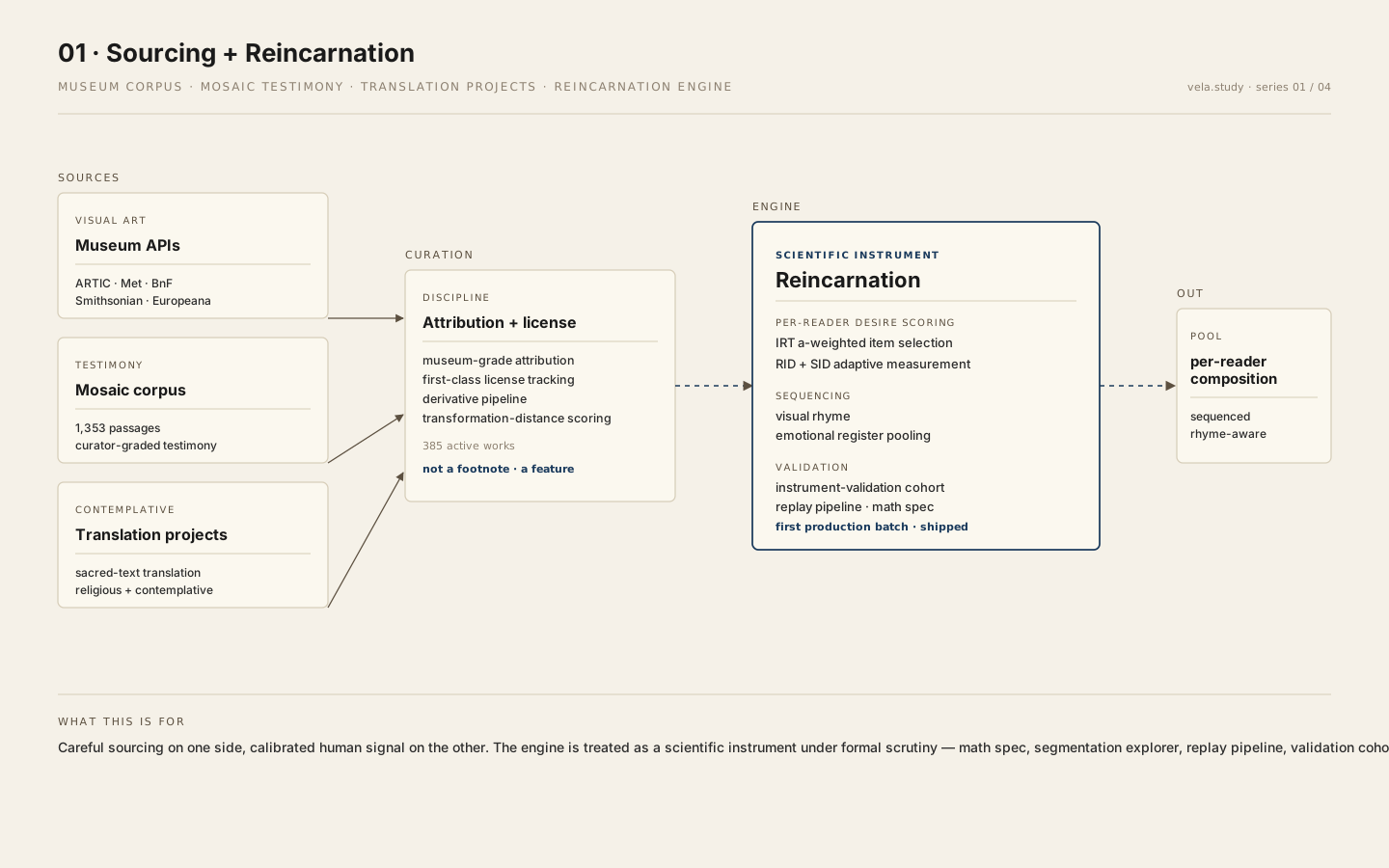
Sourcing, curation, and the Reincarnation engine.
Five museum APIs (ARTIC, the Met, BnF, Smithsonian, Europeana) supply the visual-art corpus — 385 active works pulled under museum-grade attribution and first-class license discipline. The 1,353-passage Mosaic testimony corpus and the contemplative-text translation projects (sacred-text translation across religious and contemplative traditions, broadly) sit alongside. The Reincarnation engine reads per-reader desire on the IRT-weighted axes the math spec defines and sequences the pool across visual rhyme and emotional register. The engine is treated as a scientific instrument under formal scrutiny — segmentation explorer, replay pipeline, instrument-validation cohort — because the encounter on the other side of it matters to the reader's actual life.

Five-layer Written System and the Narrative Intelligence Platform.
Five layers — analytical essays, Mosaic testimony, fiction, audio readings, and reader-authored submissions — coexist on one foundation. The Narrative Intelligence Platform generalizes the Mosaic editorial engine into a three-domain spine (lived, fiction, research) with six admin surfaces deployed: Dashboard, Sources, Excerpt Review, Quote Explorer, Insight Workbench, Guide Builder. Each reader's magazine begins when they arrive rather than on a publishing calendar. Three editorial axes — figurative response, emotion architecture, developmental theology — share the foundation without collapsing into each other; emotion is the core axis after the 2026-04-30 pivot. These are not features in the abstract; each is an instrument for the human work of replacing belief-rooted thoughts and emotional patterns that work against a life and community with ones that work for them.
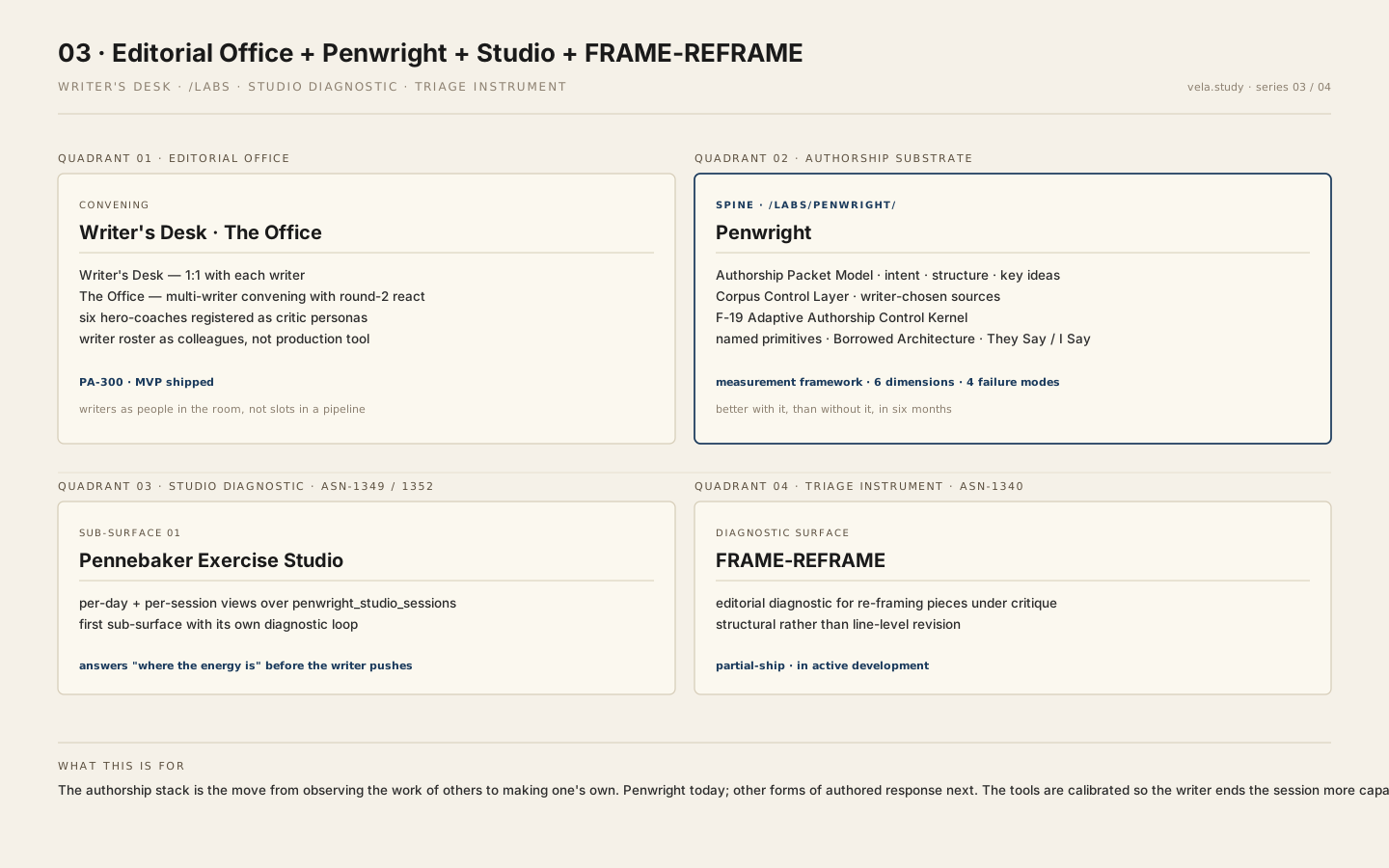
Editorial Office, Penwright, the Pennebaker Exercise Studio, and FRAME-REFRAME.
The Editorial Office turns the writer roster from production tool into colleagues — Writer's Desk for one-on-one work with each writer, The Office for multi-writer convening with a round-2 react. Penwright lives in /labs as the authorship instrument: Authorship Packet Model, Corpus Control Layer, the F-19 Adaptive Authorship Control Kernel as the spine, and a growing set of named writing-method primitives (Borrowed Architecture, They Say / I Say). The Pennebaker Exercise Studio is the first sub-surface to receive its own per-day and per-session diagnostic over `penwright_studio_sessions`; FRAME-REFRAME is the editorial triage instrument for re-framing pieces under structural critique. The arc the authorship stack is built for is the move from observing the work of others to making one's own — Penwright today; other forms of authored response next.
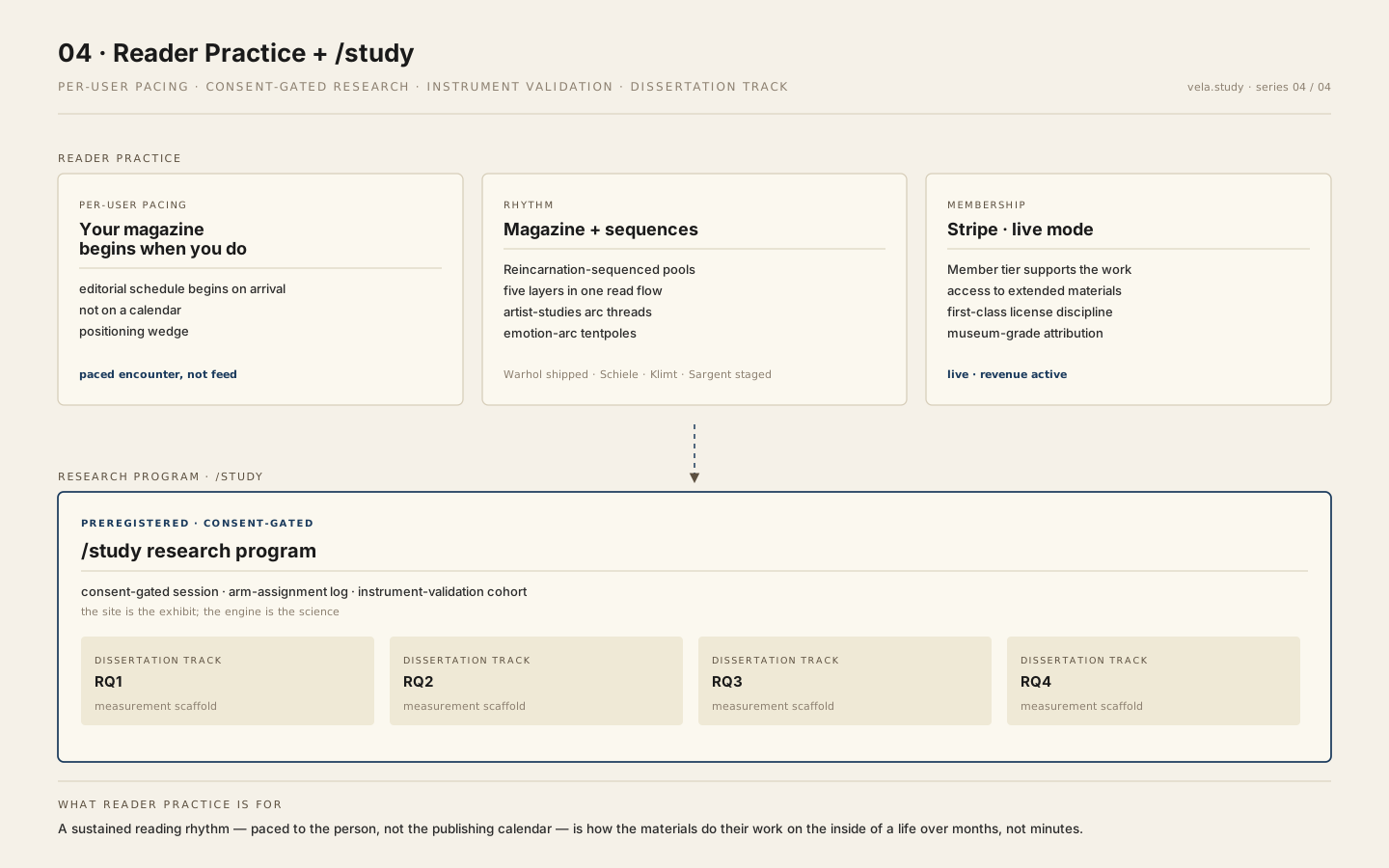
Reader practice and the /study research program.
Your magazine begins when you do — paced to the reader, not to a publishing calendar — and Stripe membership is live so the work is supported by the people it is for. Underneath the magazine sits /study: a preregistered research program with consent-gated session, arm-assignment log, instrument-validation cohort, and dissertation-track scaffolds for RQ1 through RQ4. The site is the exhibit; the engine is the science. A sustained reading rhythm — months, not minutes — is the shape in which the materials do their work on the inside of a life and the communities a life is part of. The word for what that work is, when all of these instruments are doing their part, is liberation.
Writing
- A Poverty of Attention
Thesis · the adaptive magazine
- The Failure Record
Field guide · AI failures
- Science: Why The Math of People is Different Than Machines (And Why Statistics Alone Won't Save You)
4S · Science
- You Don't Pick the Architecture. You Catch It.
Architecture · Cross-portfolio